

Choosing the right tractor for your specific needs can be a daunting task. With numerous brands and models available on the market, it can be difficult to distinguish the options based on quality and durability. In this guide, we’ll compare the two renowned brands, John Deere and Kubota, backed by state-of-the-art technology. We’ll focus on performance, quality, and pricing, as well as our thoughts on our experience with ag and construction machinery. Let’s get started to see the faceoff between Kubota vs John Deere!
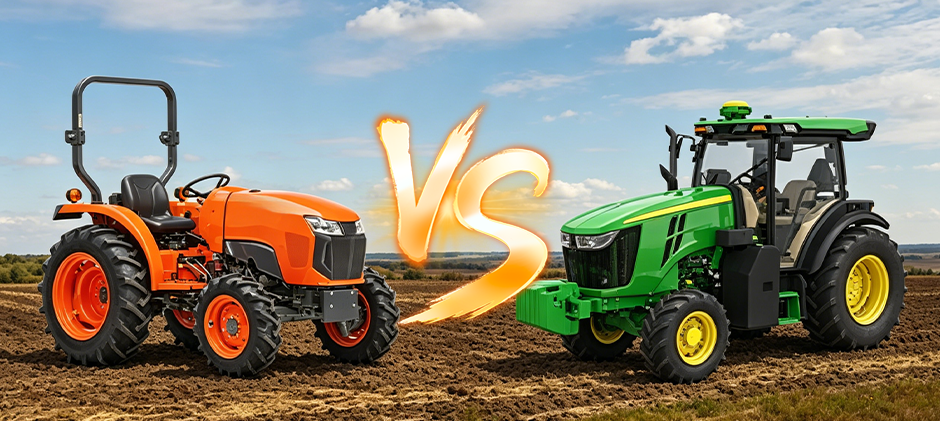
An Overview of Kubota vs John Deere
John Deere and Kubota are both the most recognized names in the compact tractor space. To be entirely forthright, in the Kubota vs John Deere debate, you really cannot pick a loser. There are no perfect tractors nor does one best the other in certain areas.
About Kubota Tractors
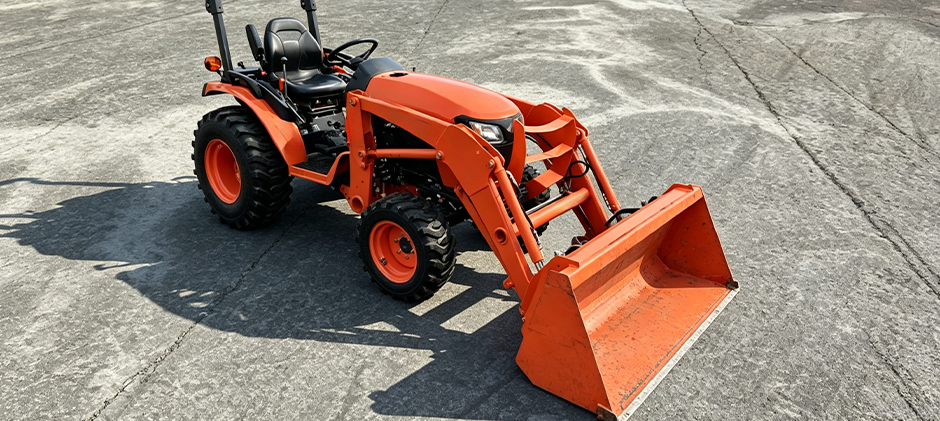 Kubota is recognized as the architect of the modern compact tractor market since planting its flag in the U.S. during the 1960s. It has treated the sub-40HP diesel segment as its personal “home turf”, evolving into the globally recognized leader that now commands roughly 25% of the U.S. compact market.
Kubota’s legacy is built on a foundation of unrivaled owner satisfaction. It consistently secures the #1 spot in surveys of “Most Durable” and “Best Ownership Experience”, with the fewest reported problems per unit of any major brand(0.76 issues per tractor versus the average of 1.21).
About John Deere Tractors
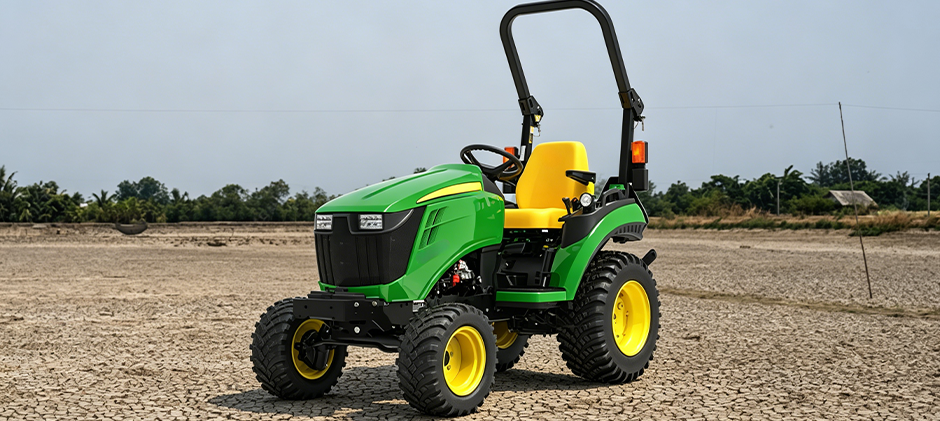
While Kubota dominates through specialized focus, John Deere commands the market through unmatched historical gravity. It has been building tractors since the early 1900s and has leveraged its massive global recognition to fuel an aggressive and highly successful expansion into the compact tractor space.
John Deere finds its advantage in record-breaking loyalty statistics with the highest repeat-purchase rate of 52%. That loyalty is driven by brand culture, dealer experience, and strong resale values rather than raw capability advantages in the compact class.
Model Lineup Comparison Table
The table shows how the Kubota and Deere series map each other to help you make an apple-to-apple comparison when shopping.
| John Deere Series | Approx HP | Kubota resires | Approx HP |
|---|---|---|---|
| 1 Series (1023E, 1025R) | 21-24 hp | BX Series / B2301 | 16-26 hp |
| 2 Series (2025R, 2032R, 2038R) | 24-37 hp | LX Series / Small L | 4-39 hp 4-39 hp |
| 3 Series | C24-45 hp | L Series (L2501-L4802) | 24-48 hp |
| 4 Series | 43-75 hp | MX / M4 Series | 60-73 hp |
Reliability of Kubota vs John Deere
Here’s one of the largest surveys of US tractor owners to tell you the numbers.
| Metric | Kubota | John Deere | Column 4 |
|---|---|---|---|
| Problems Per Unit | 0.76 | 1.20 | 1.21 |
| Ownership Experience Index | 421 | 420 | / |
| Owner Loyalty Rate | 41% | 52% | 45% |
| Compact Durability Ranking | #1 | #2 | / |
| Best Ownership Experience | #2 | #2 | / |
* Data sourced from the Progressive Farmer Reader Insights Study.
Pricing of Kubota vs John Deere
We know John Deere has a “tax” across the full lineup, the consistent price premium it commands over its Kubota equivalent. But is it really worth it?
Sub-Compact–BX vs 1025R
Kubota: Base Price; More negotiable (7-10% off MSRP)
John Deere: 10-20% higher; Less negotiable (5-7% off MSRP)
What the premium buys you:
- AutoConnect mid-mount deck (attaches from seat)
- More refined ergonomics & operator station
- Stronger brand resale in suburban markets
Verdict: Often worth it. Worth it if mowing is your primary task on a flat yard.
Mid-Compact–B/L Series vs 2R/3R
Kubota: Significantly lower; More negotiable (7-10% off MSRP)
John Deere: Noticeable Premium; Less negotiable (5-7% off MSRP)
What the premium buys you:
- Cab options on select models
- Tech & telematics features
- Better resale value at trade-in
Verdict: Hard to justify if loader work and grading are your main jobs.
Large-Compact–MX/M4 series vs 4 series
- Kubota: Lower upfront; More negotiable (7-10% off MSRP)
John Deere: Premium persists; Less negotiable (5-7% off MSRP)
What the premium buys you:
- Integrated telematics (JDLink)
- Premium cab options & comfort
- Full green-fleet integration
Verdict: Depends on whether you’re building a green fleet or buying standalone.
DPF Difference of Kubota and John Deere
Kubota’s edge over John Deere in the compact segment is also about how each brand handles Tier 4 emissions compliance and the downstream effect on real ownership experience.
Kubota’s approach–engineer around the problem
Kubota deliberately sizes its smaller engines to stay below the horsepower thresholds that trigger mandatory diesel particulate filter (DPF) requirements. Most BX and B-Series machines achieve Tier 4 compliance through efficient combustion and internal EGR alone — no DPF, no regeneration cycles, no warning lights. Larger L, MX, and M-Series models do carry DPF systems where regulations require it, but below 25 HP, Kubota’s lineup is largely DPF-free by design.
John Deere’s approach–comply with the filter in place
Many Deere 1-, 2-, and 3-Series compact tractors over ~24-25 HP use DPF systems that periodically regenerate. For buyers doing short cycles, light loads, or frequent idling — exactly how most suburban compact buyers operate — DPF clogging is a real risk that triggers warning lights and dealer visits.
Dealer Network of John Deere and Kubota
This is one area where John Deere’s advantage is consistent and hard to argue with. John Deere boasts one of the largest dealer networks across the USA with an estimated 700+ag/turf dealers. Its dealership spans across the Midwest and holds a strong presence in both rural and suburban markets.
Kubota expands aggressively and now operates over 1,000 dealers across North America, but the network is often viewed as less strong than its Deere counterparts in some regions. And many owners think the Kubota dealer quality variation is wider.
So, when you are making a purchase decision, visit your local dealer and ask how long the parts typically take to arrive and the labor rate as well. The quality of your local dealer will affect your ownership experience far more than which brand you choose. A great dealer relationship is worth thousands of dollars over the life of a machine.
Parts, Service & DIY Practicability
The parts and service cost difference between brands is real. The table below shows the parts price, availability and service.
| Factor | Kubota | John Deere |
|---|---|---|
| OEM Parts Pricing | Lower | Higher |
| Aftermarket Parts Availability | Strong | Very Strong |
| Dealer Labor Rates | Generally lower | Generally higher |
| DIY Serviceability | Excellent | Good |
| Electronics Complexity Value 5 | Low (most models)Higher | Higher |
| Parts Availability (older models) | Good, some gaps 10+ yrs | Very good |
The OEM price of Kubota parts is generally lower than that of John Deere as well as the dealer’s labor rates. Both Kobuta and John Deere have good OEM and aftermarket parts availability regarding modern or older models. But John Deere has stronger parts availability than Kubota due to its large dealer network. Despite this, Kubota is more beginner-friendly in DIY repair due to its straightforward mechanical layouts and minimal proprietary electronics on most models. At FridayParts, you can buy an extensive selection of high-grade tractor parts.
Resale Value of Kubota and John Deere
The resale value of John Deere tractors far outweighs that of Kubota tractors. A John Deere compact tractor usually commands the highest resale prices at auction or dealer trade-in, almost near-new prices in tight markets. Since Kubota and Deere take up about 70% of the compact tractor market share, they are highly liquid in the used market, with Deere’s brand recognition giving it an obvious edge.
More importantly, the Deere’s high resale value can offset part of the initial price premium in the long term. But in some regions where Kubota is more popular, Kubota resale is stronger and the gap narrows considerably with Deere tractors.
Operational experience of Kubota and John Deere
With roomy stations, intuitive controls, adjustable seating and features like the AutoConnect mid-mount deck and Quik-Park loader, the operational experience of John Deere is much better than that of the Kubota tractor. Deere buyers always praise Deere as more “automotive” with premium lift and finish. However, Kubota has narrowed the gap in recent years. It takes simplicity as an advantage, with fewer buttons and fewer systems, which means fewer things to go wrong. That’s what beginners prefer.
In terms of technology, John Deere emphasizes integrated telematics, precision ag tools and advanced electronics in larger and utility models. Kubota is focused on durable, straightforward equipment, excelling in the loader performance, ground clearance and implement capacity with less emphasis on farm-management tech in the under 40 HP class.
Kubota vs John Deere: Which One Should You Choose?
Both Kubota and John Deere have their unmatched advantages. Here are simple suggestions for you.
Choose Kubota if you:
- Prioritize reliability at lower initial costs
- Prefer DIY repair works
- Prefer mechanical simplicity
Choose John Deere if you:
- Value premium ergonomics and advanced technologies
- Prioritize a strong dealer network and good dealer experience
- Prefer strong resale value
Conclusion
Selecting the right tractor depends on your specific needs. Always go to the local dealers for parts availability and service experience. On financing, both brands offer competitive deals, so shop around before you commit. At FridayParts, you can source a vast selection of high-quality Kubota tractor replacement parts and John Deere tractor replacement parts for various models. Our selection includes everything you need to bring your tractor back to life quickly.
Articles You Might Also Like
Cub Cadet vs John Deere: Which One Should I Choose as My First Riding Mower
