

Weight varies more than you might expect. Bobcat compact tractors range from 1,521 lb to 4,685 lb at base operating weight, depending on series. The 2000 and 4000 Series cover everything in between. Most of that spread comes from factory cabs and configuration options rather than the tractors themselves. Base figures are a starting point, though, not a towing number. Add a loader, backhoe, or rear ballast and the real Bobcat tractor weight on the trailer shifts fast. Here is the full breakdown by series, plus how to calculate what you are actually hauling.
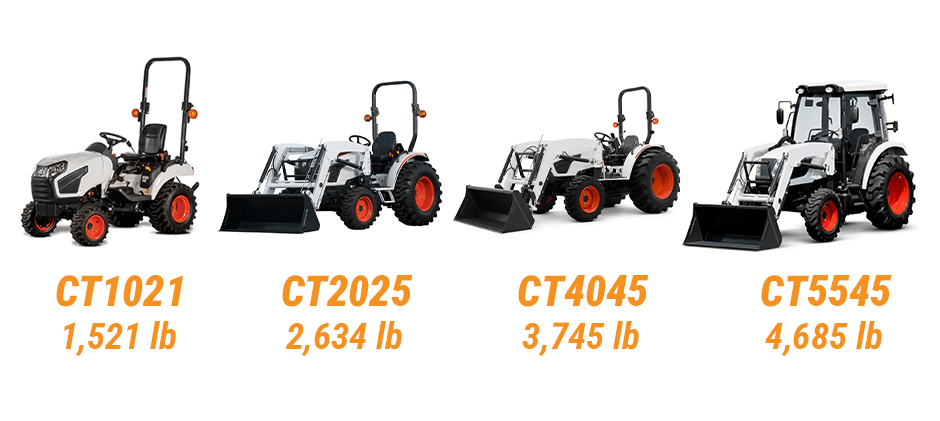
Weight Breakdown by Platform
Each series below lists Bobcat tractor weight for every current model. Read these as a floor, not a loading figure. Anything bolted on or filled after that — a loader, a backhoe, a cab on an open-ROPS machine, liquid in the rear tires — pushes the figure up. Put the machine on a certified scale with its attachments and ballast in place, and the Bobcat tractor weight commonly comes back several hundred pounds higher.
1000 Series Sub-Compact Models
| Series | Model | Base Operating Weight | Engine HP |
|---|---|---|---|
| 1000 | CT1021 | 1,521 lb / 690 kg | 21 |
| 1000 | CT1025 | 1,521 lb / 690 kg | 24.5 |
The CT1021 and CT1025 share identical dimensions and the same 1,521 lb operating weight. On the spec sheet, horsepower is essentially the only difference. Body width sits at roughly 45.7 inches—close enough to make a 48-inch opening look workable. That clearance is a paper figure, though. Tires, mirrors, and any mounted implement decide what actually gets through the gate. Measure the machine in the configuration you intend to run.
At this weight, the platform gives you:
- A footprint light enough for lawns and ornamental turf
- 700 lb of lift at the 3-point hitch
- 608 lb of loader lift at maximum height
Where the work stays inside a residential lot or hobby garden, maneuverability is the whole argument for the lighter frame.
2000 Series Compact Models
| Series | Model | Base Operating Weight | Engine HP |
|---|---|---|---|
| 2000 | CT2025 | 2,634 lb / 1,194 kg | 24.5 |
| 2000 | CT2035 | 3,005 lb / 1,363 kg | 34.9 |
| 2000 | CT2040 | 3,005 lb / 1,363 kg | 39.6 |
| 2000 | CT2535 | 3,585 lb / 1,626 kg | 34.9 |
| 2000 | CT2540 | 3,585 lb / 1,626 kg | 39.6 |
Three distinct weight tiers sit inside the 2000 Series. The CT2025 comes in at 2,634 lb, roughly 1,100 lb above the 1000 Series machines. CT2035 and CT2040 share a platform at 3,005 lb and differ mainly in engine tuning. The CT2535 and CT2540 move up to 3,585 lb, a jump accounted for by the cab.
The cab is not merely a comfort option. Weather and debris protection is only part of what a cab adds. The steel structure, HVAC hardware, glass, and door assemblies all sit on the upper half of the machine, well above the operator platform rather than low in the frame. That higher mass becomes noticeable on side slopes and under heavy loader cycles—particularly for anyone coming off an open-ROPS tractor, where the machine settles differently.
4000 Series Compact Models
| Series | Model | Base Operating Weight | Engine HP |
|---|---|---|---|
| 4000 | CT4045 | 3,745 lb / 1,699 kg | 44.9 |
| 4000 | CT4050 | 3,745 lb / 1,699 kg | 49.6 |
| 4000 | CT4058 | 3,745 lb / 1,699 kg | 57.7 |
| 4000 | CT4545 | 4,300 lb / 1,950 kg | 44.9 |
| 4000 | CT4558 | 4,300 lb / 1,950 kg | 57.7 |
The CT4045, CT4050, and CT4058 all weigh 3,745 lb in base configuration as open-ROPS machines. The CT4545 and CT4558 are heavier cab-equipped models within the same 4000 platform, with a published operating weight of 4,300 lb. Horsepower rises across the lineup, but within each configuration group the base operating weight stays consistent.
Moving between these models is where towing plans most often go wrong:
- Even two open-ROPS machines at the same 3,745 lb need attachment weights, fuel level, and ballast checked again before a tow.
- Going from open ROPS to a CT4545 or CT4558 adds about 555 lb before a single attachment is counted (4,300 − 3,745).
- Among same-weight models, the choice usually comes down to PTO horsepower — rotary cutters, tillers, and post-hole diggers are what separate 44.9 hp from 57.7 hp in daily use.
- Any change in configuration means rechecking the trailer against the machine as it will actually be loaded, not against a figure worked out for an earlier setup.
5000 Series Compact Models
| Series | Model | Base Operating Weight | Engine HP |
|---|---|---|---|
| 5000 | CT5545 | 4,685 lb / 2,125 kg | 45 |
| 5000 | CT5550 | 4,685 lb / 2,125 kg | 50 |
| 5000 | CT5555 | 4,685 lb / 2,125 kg | 55 |
| 5000 | CT5558 | 4,685 lb / 2,125 kg | 57.7 |
The CT5545, CT5550, CT5555, and CT5558 all weigh 4,685 lb. These models are published with a factory cab, electronic hydrostatic transmission, and a 3-point lift capacity at 24 inches behind the lift point of 3,177 lb on the CT5558. Rear lift in that range opens up mid-size implements that the smaller platforms simply cannot carry.
It is the frame for mixed-use rural properties handling baled hay, box blades, and heavier ground-engaging tools. Deck length and axle rating deserve a look before the purchase order, not after. Plenty of landscape trailers that are adequate behind an open-ROPS 4000 run out of brake capacity once a cab-equipped 4000 or any 5000 Series is on the deck.
How Weight Shapes Real Work
Stability on Slopes and Uneven Ground
Weight alone buys no stability. Rollover risk on a grade is the product of several things at once:
- Front and rear track width
- Center of gravity height, which rises with a raised loader
- Tire size, type, and inflation pressure
- Where the ballast sits
- Ground surface and moisture
- Operator inputs like turning speed and sudden braking
Extra weight can make a tractor feel more planted during steady work. That impression does not hold once the loader is raised, because mass carried high works against stability no matter what the base weight says. Cross slopes with the loader low, ease off through turns on a grade, and stay within the slope limits set out in the operator’s manual for your machine. Your particular configuration is covered in the manual, not on the spec sheet.
Traction and Pulling Power
Weight on the drive wheels is what converts engine horsepower into actual ground work. Two 45 hp tractors. One at 2,700 lb, one at 3,500 lb. They will not handle the same implement. The heavier machine holds traction longer before the wheels slip. More weight over the drive axle generally delays that slip.
The usual ways to add it:
- Liquid tire ballast. Calcium chloride, beet juice, or windshield washer fluid in the rear tires. Weight lands directly over the drive axle. The pounds added depend on tire size, so use the fill chart for your casing, not a generic figure.
- Rear ballast box. A 3-point box filled with concrete, sand, or scrap steel. Counterweight sits behind the rear axle. It also occupies the hitch. Take it off whenever a rear implement is needed. Owners who swap implements constantly are better served by wheel weights. For tractors that rely on the 3-point hitch for lifting and pulling, hydraulic cylinder seal kits help maintain smooth hitch response and reliable lift performance.
- Cast iron wheel weights. Bolt-on plates. Ride height, ground clearance, and the 3-point hitch stay untouched.
R4 industrial tires are a tire type, not a ballast method. The casing contributes little next to a fluid fill. Which route you take comes down to two things. How often rear implements get swapped. And how much permanent weight the drive axle rating allows.
Calculating Real Transport Weight
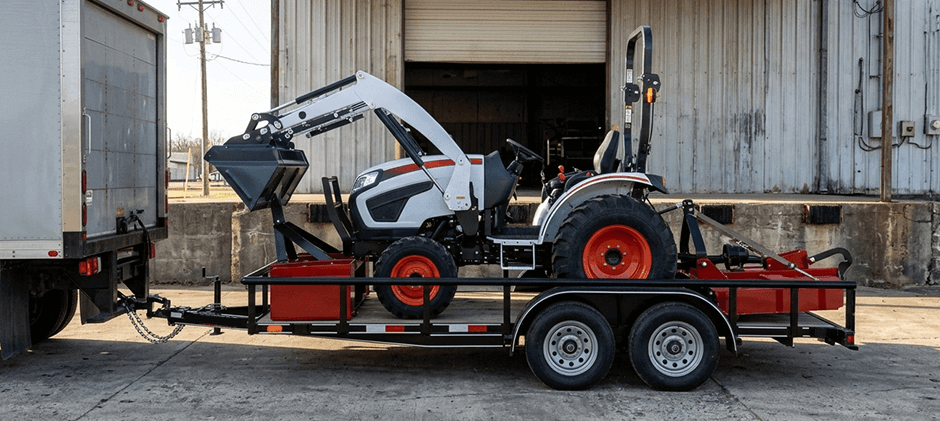
Bobcat tractor weight is where the arithmetic starts, not where it ends. Anything travelling with the tractor belongs in the total the trailer has to carry. It helps to build the number in stages:
| Stage | What It Includes |
|---|---|
| Base operating weight | Tractor with fluids, no attachments |
| Operating weight with loader | Base plus front loader frame, arms, bucket, and quick-attach |
| Operating weight with backhoe and ballast | Previous stage plus rear backhoe or ballast box |
| Actual transport weight | Previous stage plus fuel, tools, and any mounted implements |
For each attachment, pull the specification sheet for the exact model you plan to mount. A front loader for a CT2025 does not weigh the same as a loader for a CT5558. Published loader and backhoe weights are available from Bobcat for each matched combination. Use those numbers, not estimates.
Trailer Load vs. Combined Tow Weight
With an actual transport weight in hand, two totals need to be kept separate:
- Trailer load = tractor actual transport weight (what sits on the deck)
- Combined tow weight = trailer load + trailer empty weight (what the tow vehicle actually pulls)
Mix them up, and the rest of the calculation goes wrong. Start with the machine: 4,685 lb. Add the equipment trailer: 2,200 lb. That is 6,885 lb combined, before fuel, tools, or chains. Two numbers then have to work. The trailer’s payload rating covers the machine on the deck. The tow vehicle’s GCWR covers the whole combination.
Both numbers then have to survive the following checks:
- Trailer GVWR must exceed the combined tractor and attachment weight plus trailer tare
- Payload capacity, not GVWR alone, must cover the load on the deck
- Trailer axle ratings must support the loaded weight on each axle
- Electric or hydraulic brakes should be rated for the maximum towed weight
- Tow vehicle hitch rating and GCWR must support the full combination
- State regulations may call for specific brake and lighting setups above certain weights
Before a long haul, put the whole rig on a certified scale. The ticket costs little and settles the question of whether the figures on paper describe the load actually going down the road.
Matching Weight to Your Property
Acreage and the kind of work the property demands narrow the field to a general size range:
- Acreage. Under two acres generally suits the 1000 Series or a smaller 2000; two to ten acres tends to land on the 2000 or 4000; beyond ten acres, the 4000 and 5000 come into play.
- Primary task. Mowing tolerates a light frame. Repetitive loader cycles and ground engagement reward mass.
- Soil type. Dry, well-drained ground accepts any of these weights. Wet clay and soft pasture argue for a lighter frame or wider tires to limit compaction.
- Storage. A cab model needs vertical clearance. Measure your building door before committing to a 2535, 2540, cab-equipped 4000, or any 5000 Series.
Acreage alone does not decide the right machine. Bobcat tractor weight matters as much as acreage when matching a machine to the work. A 1.5-acre property with steady loader work can justify a 4000 Series, while 12 acres of light mowing may never need more than a 2000. Workload, implement size, and loader duty cycle belong in the decision alongside land area.
Owners running a working rural property rarely pick a tractor by weight class alone. What they are really weighing is acreage against the implements the job calls for, and both against the practical question of getting the machine where it needs to go. Lighter open-ROPS models keep that last part easy: nimble on the property, straightforward on a trailer. Step up to a mid-range frame, and the gains show up in traction and 3-point capacity. Go further, into the heavier cab-equipped machines, and you get comfort and lift strength—paid for in trailer requirements and storage space.
Final Words
The right Bobcat tractor weight matches mass to the job. Light enough to move and tow. Substantial enough to pull, lift, and hold its footing when conditions turn against it. Start with the figures here as a verified baseline. Add the published weights of the loader, backhoe, and ballast that will actually travel with the machine. Only after that, sign off on a trailer. Service is the other half of ownership. FridayParts carries aftermarket filters, seals, hydraulic components, and wear items with wide compatibility across compact tractor and heavy equipment brands. A dependable replacement source, without the dealer-counter price.
