

Don’t know what wires go to your ignition switch on your mower? In this guide, we’ll walk you through the 3 pole and 4 pole starter solenoid wiring diagram and help you determine whether to convert to a 4-pole starter solenoid.
What Is A Starter Solenoid?
A starter solenoid, aka a solenoid switch or a solenoid, functions as a heavy-duty relay to handle the substantial electrical current required to turn over an engine. When you turn your ignition key, a small control current energizes the solenoid’s coil, which then closes internal contacts, allowing full battery power to reach the starter motor. The wiring diagram shows these electrical pathways, terminal connections, and safety circuits. Incorrect wiring can lead to:
- Burned ignition switches
- Damaged starter motors
- Fire hazards from short circuits
- Complete electrical system failure
Starter Solenoid Wiring Diagram
A starter solenoid wiring diagram shows how to connect wires. The symbols and numbers for each terminal help you find where each wire goes. People should use the right wire thickness for each connection. Thick wires move power from the battery to the starter motor. Thin wires are for the activation circuit. Good grounding keeps the wiring safe and working well. Diagrams always show where to put the ground wire.
Starter Solenoid Terminal Identification
Knowing the labels of each terminal helps you better understand the diagram and determine what wires go to the starter solenoid. The table below shows the labels and common wire color code of a starter solenoid.
| Terminal/Function | Common Wire Color(s) |
|---|---|
| Battery (B) | Red |
| Start (S) | Yellow or Purple |
| Motor (M) | Black |
| Relay (R) | Blue |
| Ignition (I) | Brown |
| Ground | Green or Bare |
3 Pole vs 4 Pole Starter Solenoid: What’s the Difference?
The key difference between a 3-pole and a 4-pole starter solenoid lies in their wiring configurations and applications. While both types of solenoid perform the same function of connecting the battery to the starter motor, they achieve this in slightly different ways. The number of terminals indicates whether there’s a separate ground circuit for the solenoid’s coil. Let’s take a look at the 3 pole and 4 pole starter solenoid diagrams for better understanding.
3 Pole Starter Solenoid Wiring Diagram ( for reference only)
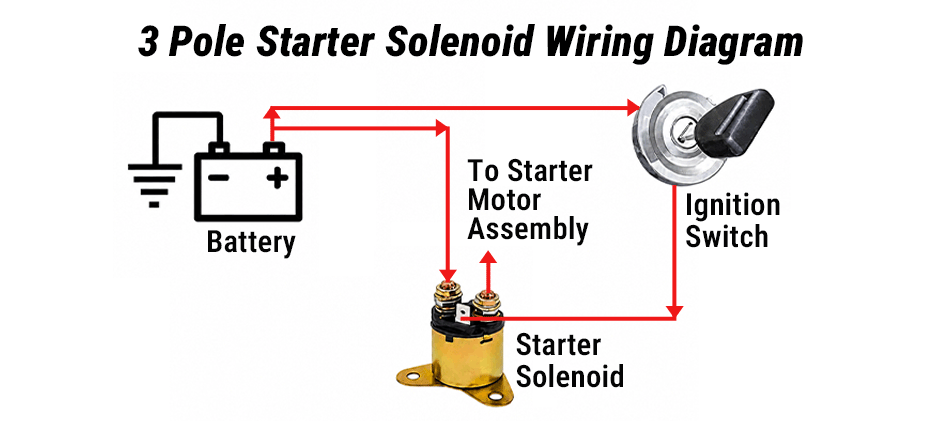
There are 3 terminals in this solenoid:
- Battery Terminal: One of the large terminals connects to the battery positive (+) terminal
- Starter Motor Terminal: The other large terminal connects to the starter motor
- Activation Terminal: The small terminal receives the signal from the 12V ignition switch to activate the solenoid
In a 3-terminal starter solenoid, the solenoid relies on being grounded through the mounting bracket to the mower’s frame. The frame itself must be well grounded to the battery’s negative (-) terminal. If the frame ground is poor due to rust, corrosion, or loose connections, the solenoid may not function correctly.
This kind of solenoid is often used on older mowers with a simple electrical system and applications where a reliable frame ground is present.
4 Pole Starter Solenoid Wiring Diagram ( for reference only)
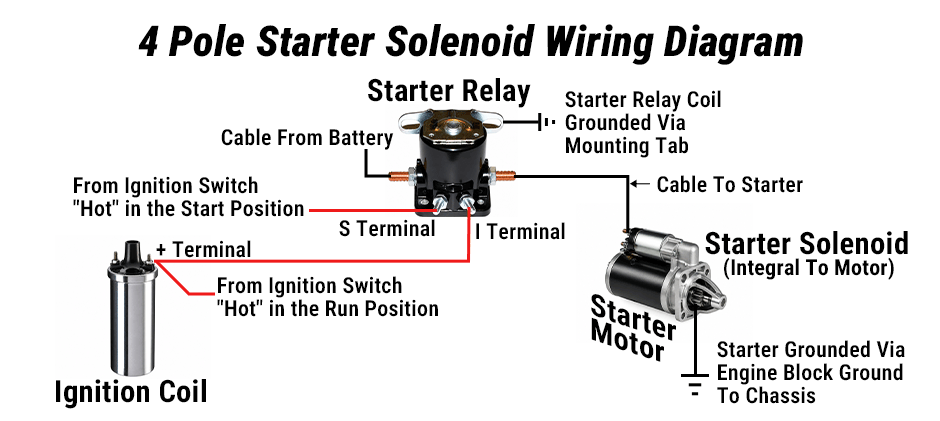
A 4-pole starter solenoid has the same three connections as a 3-pole one, plus an additional ground terminal:
- Battery Terminal: One large terminal connects to the battery’s positive terminal
- Starter Motor Terminal: The other large terminal is connected to the starter motor
- Activation Terminal: This terminal connects to the ignition switch
- Ground Terminal: The starter solenoid has a dedicated terminal connected directly to the battery’s negative (-) terminal or a dedicated ground point on the mower’s frame
In the 4-terminal setup, the dedicated ground terminal provides a direct and reliable ground path for the solenoid’s coil, regardless of the condition of the mower’s frame. This makes 4-terminal solenoids more reliable in situations where a good frame ground is questionable. Some 4-terminal solenoids use the fourth terminal as an ‘S’ or ‘Start’ terminal to route through safety switches, such as the seat switch or PTO switch. This configuration ensures the mower can only start when the operator is seated or the PTO is disengaged.
This kind of starter solenoid is commonly used on newer mowers with more complex electrical systems and applications where a reliable frame ground cannot be guaranteed. It is also used when the solenoid is part of a safety circuit.
How to Choose the Right Starter Solenoid?
When replacing your mower’s starter solenoid, you must consider the following factors.
- Original Solenoid Type: Using the same type of starter solenoid is a wiser and safer option.
- Wiring Diagram: You should refer to your mower’s wiring diagram to confirm the wiring configuration
- Grounding: If you use a 3-terminal starter solenoid, you should ensure a clean and secure ground connection between the solenoid mounting bracket and the mower frame.
- Safety Circuits: If your mower has safety switches in the starting circuit, you will need a 4-terminal solenoid to maintain those safety features.
- Amperage Rating: Choose a solenoid with the same amperage rating as the original one. A premature failure would occur due to a lower or higher rating.
Can I Convert from 3-Terminal to 4-Terminal Starter Solenoid?
While you’d better stick with the original type of starter solenoid, it’s sometimes possible to convert between 3-terminal and 4-terminal solenoids. There are factors to consider:
3-Terminal to 4-Terminal
The shift from a 3-pole starter solenoid to a 4-pole one is generally straightforward. All you need to do is connect the additional terminal on the 4-terminal solenoid to a reliable ground point on the mower’s frame or to the battery negative terminal. This ensures a good ground connection, even though the frame ground is poor.
4-Terminal to 3-Terminal
Not recommended. This conversion is possible ONLY if the fourth terminal on the 4-terminal solenoid is a ground. If the fourth terminal is part of the safety circuit, we recommend not doing this conversion because it will disable safety features. You should omit the ground wire for this shift and make sure the solenoid has a good frame ground through its mounting bracket.
WARNING: Disabling safety switches can lead to serious injury or death. Never bypass or disable safety features on your mower.
Wrapping up
A starter solenoid is a crucial part in turning over your mower engine. Understanding the 3 pole and 4 pole starter solenoid wiring diagram can help you better solve related electrical problems. When you need a replacement lawn mower starter solenoid, we advise you to choose the same solenoid as the original one. If you have to convert the 3 pole starter solenoid to a 4 pole one, you must refer to your owner’s manual and considerations listed in this blog. At FridayParts, you can source a vast range of quality starter solenoids and other mower replacement parts to keep your machine running at its optimal performance. Enjoy your new ride now!
See Related
How to Test A Starter Solenoid?
