

If your loader bucket keeps skimming across packed dirt, a tractor bucket tooth bar can help, but it’s usually only half of the fix. Teeth give the bucket more bite, so it cuts in faster and loads better. Still, hard clay and baked soil often need to be loosened first with a box blade and scarifiers. That is where many people waste time and put too much strain on the loader. The sections below break down when a tractor bucket tooth bar is worth buying, when it falls short, and what setup works better in hard ground.
Do Bucket Teeth Really Work On A Compact Tractor?
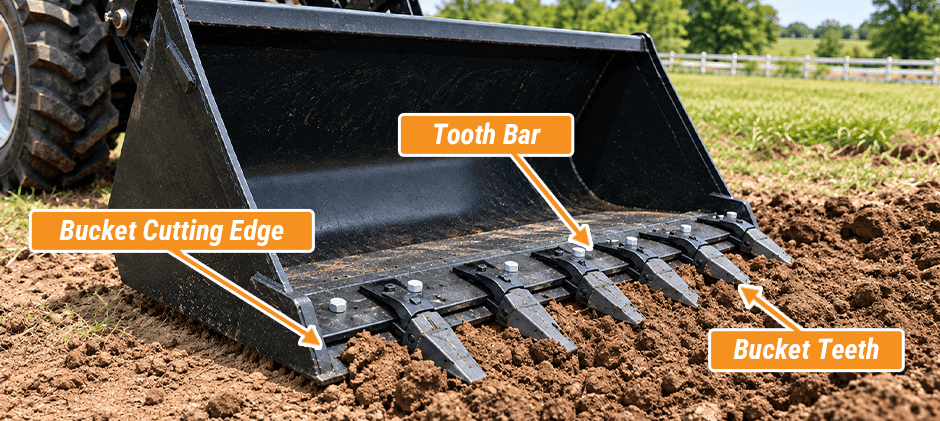
Yes, a bucket tooth bar or bolt-on tooth bar can make a real difference on a 25 to 40 hp compact tractor. The bucket teeth cut the ground at several points instead of asking the whole flat edge to bite at once. That lowers the initial resistance and helps the bucket start digging sooner.
What usually improves:
- Breaking into packed dirt
- Pulling saplings and shallow roots
- Loading gravel, soil, and old piles
- Back dragging rough ground
- Protecting the bucket edge
What usually does not change:
- Loader lift capacity
- Loader arm strength
- Traction on loose ground
- The need to loosen rock-hard clay first
That is why opinions on tractor bucket teeth can sound split. If the job is brush, gravel, packed fill, or surface digging, many people see a big gain. If the job is deep excavation into hardpan with a light tractor, the result can feel underwhelming.
Tooth Bar Vs Toothed Bucket
| Option | Best Use | Main Benefit | Main Limit |
|---|---|---|---|
| Bolt-on tooth bar | Compact tractors, mixed loader work | Lower cost, easier upgrade, keeps original bucket | Still limited by tractor weight and loader force |
| Toothed bucket | Dedicated digging work | Strong digging setup | Higher cost, less flexible for general work |
| Flat bucket edge | Loose material, finish work | Clean edge, simple | Weak in packed soil |
For many compact machines, the best bolt-on tooth bar for compact tractor use is the one that fits the bucket correctly and matches the edge thickness. Some clamp-on designs fit cutting edges up to 1/2 inch, while heavy-duty versions fit 5/8 to 3/4 inch cutting edges. Some models will not seat properly if the blunt edge is 3/16 inch or thicker. Fit matters as much as tooth shape.
This is also where related parts matter. A bucket that already has a worn edge, bent lip, or tired mounting hardware will never perform as well as one with a solid cutting edge and fresh bucket pins and bushings.
Bolt-On Bucket Tooth Bar Vs Toothed Bucket
If the goal is to fix a loader bucket that “won’t dig,” a tooth bar for loader bucket use is usually the smarter first step than buying a full toothed bucket.
A compact tractor tooth bar works well because it upgrades the bucket already on the machine. That keeps cost down and helps with mixed jobs like grading, light digging, gravel handling, and brush cleanup.
Why A Tooth Bar Usually Makes More Sense?
Lower entry cost
A tooth bar is usually far cheaper than a second bucket.
Easy install
Many bolt-on styles need only two side holes. Some clamp-on styles install with set screws and an Allen wrench.
Keeps bucket versatility
Some tooth bars still allow decent back dragging and general loader work.
Fits more than one type of task
Packed dirt, brush, roots, and gravel are all fair game.
Still, there are limits. A tractor bucket tooth bar does not turn a compact tractor into a skid steer or crawler. If the bucket angle is wrong, ballast is missing, or the soil is baked hard, you can still stall the cut or stress the loader.
Practical Limits To Respect
- Hard clay may still need a first rip pass
- Very dry ground can stop even a good tooth bar
- Small tractors run out of traction before the tooth bar runs out of bite
- Loader abuse can damage pivot pins, loader arm bushings, and hydraulic cylinders
If the choice is between “keep fighting the flat bucket” and “add a tooth bar,” the tooth bar for tractor bucket setup is usually worth it. If the choice is between “tooth bar only” and “correct workflow,” the workflow wins.
How to Dig Hard Packed Dirt Without Hurting the Loader?
This is the part many people miss. If packed soil is beating the bucket, do not start by charging harder. Start by loosening the ground.
The better method is simple:
- Rip the surface with a box blade scarifier
- Make another pass if the soil is still tight
- Scoop with the loader after the ground is broken
- Grade and smooth on the finish pass
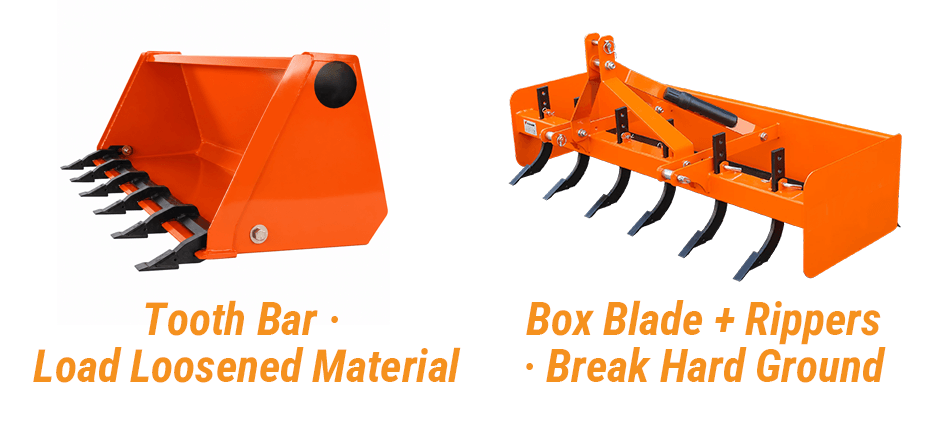
That sequence puts the force where it belongs. A box blade with rippers is meant to break hard ground. A loader bucket is meant to load, carry, and shape material. When the loader is forced to do the ripping job, the machine pays for it.
Why The Box Blade And Ripper Combo Works Better?
| Tool | What It Does Best | Why It Helps |
|---|---|---|
| Box blade with rippers | Breaks compacted soil | Reduces shock load on loader |
| Scarifier shank | Cuts and loosens hard layers | Opens the surface for the bucket |
| Ripper shank | Penetrates packed dirt and clay | Makes repeat passes easier |
| Tractor bucket tooth bar | Loads loosened material | Fills the bucket faster |
If you want to know how to dig hard-packed dirt with tractor equipment without twisting things up, this is the clean answer. Rip first, then scoop.
That also makes maintenance easier over time. You put less strain on loader pins, hydraulic hose assemblies, hydraulic couplers, and front axle parts. It is also smart to keep an eye on box blade scarifier shanks, box blade ripper teeth replacement parts, and the loader bucket edge itself, because those are the parts doing the real work.
How To Choose The Right Tooth Bar And Setup?
Not every tractor bucket tooth bar fits every bucket. Width is only part of the story.
What To Measure First?
- Inside bucket width
- Cutting edge thickness
- Blunt edge thickness
- Whether a bolt-on cutting edge is already installed
- Whether the bucket lip is worn or rolled
Some built-to-order bars are sized by actual inside width to the nearest 1/4 inch. Others are more universal but depend heavily on edge thickness. For example:
- Standard clamp-on styles may fit cutting edges up to 1/2 inch
- Heavy-duty clamp-on styles may fit 5/8 to 3/4 inch
- Some bars can work over a factory bolt-on cutting edge if the maker knows about it in advance
- Some bolt-on bars use 5/8 inch mounting bolts
- A step drill bit is often recommended because it hangs less than a twist bit in bucket side walls
A Simple Buying Guide
Pick a bolt-on tooth bar if:
- The bucket is used for mixed work
- A close fit matters
- Drilling two holes is not a problem
- Better digging and back dragging both matter
Choose a toothed bucket if:
- The machine spends most of its time digging
- Material handling is secondary
- Budget and storage are less of a concern
Choose a box blade with rippers first if:
- The main problem is hardpan or clay
- The loader keeps bouncing off the surface
- Digging depth matters more than brush clearing
This is also a good time to inspect teeth and shanks, wear blades, bucket cutting edges, and hydraulic adaptors if the loader setup is getting upgraded as a whole.
Tips For Better Loader Bucket Performance
A loader bucket tooth bar is simple, but setup still matters.
Installation Tips
- Clean the cutting edge first
- Clamp the bar in place before marking holes
- Use cutting oil when drilling
- A step bit usually makes the job easier
- Recheck bolt torque after the first few hours
Use Tips
- Keep the bucket close to level on the first pass
- Let the teeth cut instead of ramming forward
- Use rear ballast when lifting fuller bucket loads
- Back up slightly if curl force stalls in the pile
- Remove the bar for snow work if a smooth edge is needed
Safety Notes
- Tooth bars are sharp enough to cause serious cuts
- The bucket becomes longer, so front clearance changes
- Hitting a buried rock with the bucket dumped forward can overload the loader
- Hard digging without loosening first can stress the loader frame
A tractor bucket tooth bar helps most when used with the right angle and the right expectation. Think of it as a force multiplier, not a replacement for proper ground prep.
Final Words
If packed soil is stopping the bucket, a tractor bucket tooth bar is usually a worthwhile upgrade, but the best fix is often a tooth bar plus a box blade scarifier setup. Loosen first, then load. That saves time, protects the loader, and gets better results. When it is time to maintain the machine, FridayParts offers aftermarket parts, affordable pricing, wide compatibility, and a large inventory for many heavy equipment brands.
