

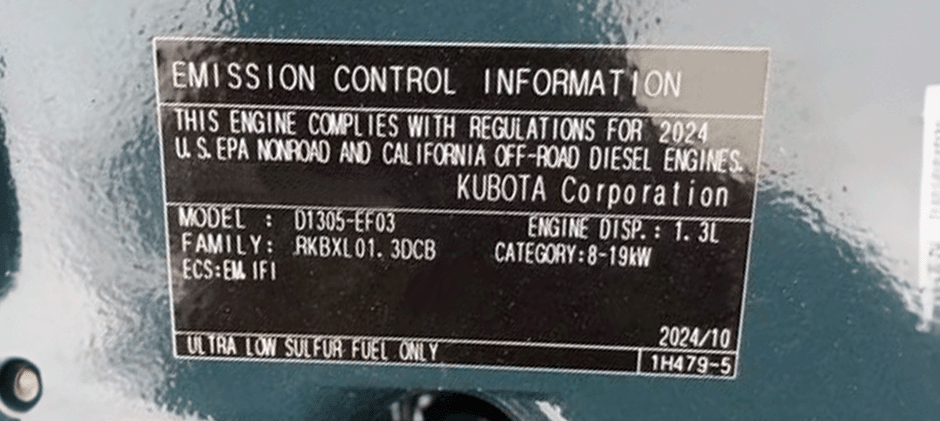
The Kubota D1305 turns up in a lot of off-road and industrial equipment, but the base engine code is only half the picture. If you’re checking one for a replacement, the first thing to look at is the tag on the engine itself—not just the listing. The suffix and rated speed can change what the engine is actually suited for.
What Is the Kubota D1305?
The D1305 is a 1.261 L, water-cooled, naturally aspirated three-cylinder diesel in Kubota’s 05 Series. It’s popular in compact machines because it packages easily and handles long daily run times, which is why you’ll find it driving hydraulic systems, generator heads, mower decks, and compressor loads in equipment with limited engine-bay space.
D1305 Specifications
Below are the main specifications of the Kubota D1305 engine.
| Item | Specification |
|---|---|
| Engine type | Vertical, water-cooled, 4-cycle diesel |
| Displacement | 1.261 L (1,261 cc) |
| Cylinders | 3 |
| Fuel system | Indirect injection (IDI) |
| Aspiration | Naturally aspirated |
| Cooling system | Liquid cooled |
| Bore × Stroke | 78.0 mm × 88.0 mm |
| Compression ratio | 24.0:1 |
| Rated power | Varies by variant |
| Firing order | 1-2-3 |
| Dimensions | 498 × 397 × 590 mm |
| Dry weight | 95 kg |
| Oil capacity | 5.7 L |
| Starting system | 12V electric start |
| Governor | Mechanical all-speed governor |
The D1305’s spec sheet is fairly straightforward. Bore and stroke are 78 mm × 88 mm, so this is more of a low-speed working engine than a high-rpm one. It’s naturally aspirated, with no turbo hardware in the system, and it uses a mechanical governor familiar to most industrial diesel shops.
The other part to check is the suffix, which is where the rated speed and power output can change.
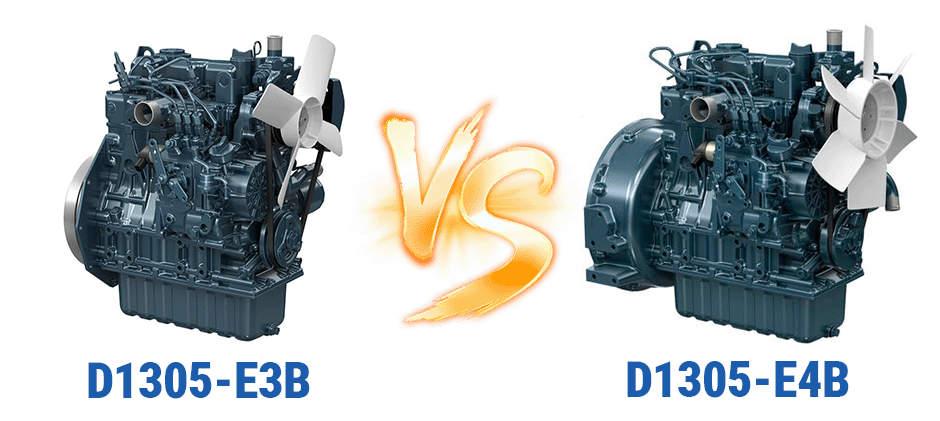
D1305-E3B vs. D1305-E4B
The E3B and E4B carry different ratings—the suffix changes both engine speed and output.
| Model | Net Power | Gross Power | Rated Speed |
|---|---|---|---|
| D1305-E3B | 28.2 HP | 29.1 HP | 3000 rpm |
| D1305-E4B | 24.0 HP | 24.8 HP | 2600 rpm |
The E4B is the lower-speed, lower-output variant. It’s typically found in equipment built around the 19 kW (25 HP) class, whereas the E3B sits a step above that range. So that 25 HP rating applies specifically to the E4B—not to every engine in the D1305 family.
That difference needs to be checked when replacing an engine in equipment such as:
- Compact loaders
- Aerial work platforms
- Sweepers
- Wood chippers
- Generators
- Turf equipment
A machine designed around a 2600 rpm engine may not respond the same way with a 3000 rpm version, even when both are badged D1305. When ordering a replacement, the suffix is part of the match, not something to figure out after the fact.
Typical Applications
The D1305 appears in a range of off-road and industrial machines where compact size and diesel durability matter. Common applications include:
- Forklifts
- Air compressors
- Aerial work platforms
- Skid steer loaders
- Generators
- Welders
- Sweepers
- Mobile fire pumps
- Wood chippers
- Mowers and turf equipment
Many of these machines spend hours at a time driving the same kind of load. Power rating, cooling layout, and basic parts support all start to matter once the machine is working every day, not sitting in a parts listing.
For regular service, most owners keep filters on the shelf first—especially the oil filter and fuel filter. On machines with a lot of hours, cooling-system parts such as the water pump, thermostat, or hoses are also common replacement items.
Emissions Standards
With the Kubota D1305 Engine, emissions details are easy to miss when a listing only shows “D1305” and leaves out the full engine code, and that’s where a lot of confusion starts. Some engines in Kubota’s broader 05 Series use low-pressure common rail, but the D1305 itself is a mechanical, naturally aspirated three-cylinder diesel.
If you’re checking one for purchase or replacement, confirm the following first:
- The D1305-E4B is tied to Tier 4 and Stage V applications.
- Suffixes may indicate emissions stage, regional specification, or equipment configuration.
- The full engine code should match the machine’s original requirements.
This tends to come up most often in export markets, mixed fleets, and machines that need to stay in the same emissions configuration as the original engine.
Service Data
The following service values are among the figures most often referenced during maintenance and troubleshooting.
| Item | Specification |
|---|---|
| Recommended oil | CF or higher |
| Viscosity | SAE 10W-30 / 10W-40 |
| Oil capacity | 5.7 L |
| Valve clearance | 0.145–0.185 mm |
| Compression pressure | 3.73–4.11 MPa |
| Injection pressure | 13.73–14.70 MPa |
These are the numbers typically checked during oil service, valve adjustment, hard-start diagnosis, and fuel-system inspection.
If the engine is already torn down, it’s worth inspecting adjacent wear items like the starter motor, thermostat, hoses, and gasket set while you’re in there. For precise procedures and service limits, the workshop manual should always be the final word.
What Does D1305 Mean?
Kubota’s model code is fairly easy to read:
- D = 3-cylinder diesel engine
- 13 = displacement class used in the naming system
- 05 = 05 Series
Here, the 13 is a naming reference rather than the exact displacement. Actual displacement is 1.261 L (1,261 cc).
Common Replacement Parts
When people look for D1305 parts, they’re usually buying one of three things: routine service items, repair parts, or overhaul components.
Routine service parts
- Oil filter
- Fuel filter
- Air filter
- Engine oil
- Coolant
Repair parts
- Water pump
- Starter motor
- Alternator
- Thermostat
- Gasket set
- Radiator hose
Overhaul parts
- Piston rings
- Main and rod bearings
- Cylinder head components
- Injector parts
- Seal kits
Buying Guide
If you’re looking for a Kubota D1305 engine for sale, fitment should come before price.
Check these points first
- Full engine model and suffix
- Rated speed
- Net and gross power
- Emissions version
- Mounting and housing pattern
- Cooling layout
- Intake and exhaust orientation
- Electrical setup
Price reference
A brand-new complete engine has been advertised at around £2,999, though that’s only a rough price point. The actual number depends on the spec, what’s included, and how the engine is being sold.
How to read suffixes
With a D1305, the suffix is part of the match. Codes such as E4B, EU, and X4 can mark differences in emissions spec, regional version, or equipment setup. Two engines can carry the same base code and still differ in speed rating, emissions compliance, or how they mount.
Practical buying advice
For a replacement, start with the machine model and the original engine tag rather than the base code in the listing. Make sure the engine matches the required E3B or E4B output, and decide whether you need a complete unit or only a few service and repair parts. If the machine is already down, ordering filters and other routine items along with the main parts usually saves a second wait.
FAQs
How much horsepower does a Kubota D1305 have?
It depends on the variant. The D1305-E3B is rated at 28.2 net HP, while the D1305-E4B is rated at 24.0 net HP.
What is the oil capacity of a Kubota D1305?
The oil capacity is 5.7 L.
Is the Kubota D1305 turbocharged?
No. The D1305 is a naturally aspirated diesel engine.
What equipment uses the D1305 engine?
It’s commonly used in forklifts, air compressors, aerial work platforms, skid steer loaders, generators, welders, sweepers, mobile fire pumps, wood chippers, and mowing equipment.
What is the difference between D1305-E3B and E4B?
The main differences are output and rated speed. The E3B is the higher-speed, higher-output version, while the E4B is rated lower and commonly used in a lower output class.
What oil is recommended for the D1305?
A diesel engine oil rated CF or higher is commonly specified, with SAE 10W-30 or 10W-40 depending on operating conditions.
Conclusion
For a Kubota D1305 replacement, the base model number is only the starting point. The suffix, rated speed, emissions spec, and mounting configuration should all be checked against the original engine before ordering. Once those details are confirmed, suppliers such as FridayParts can be a practical source for replacement engines and related service parts.
