

If a Kubota L3902 starts spinning while pulling a 5-foot disc harrow in sandy soil, the usual cause is simple: not enough usable weight on the drive tires for the draft load and disc angle. A flatter gang angle rolls easier but barely cuts. A steeper angle cuts better but asks for more traction than the tractor can hold. The fix is usually a mix of compact tractor ballast, setup changes, and lighter draft demand. Here is what to check first, where a ballast box for compact tractor use fits in, and why each fix works.
What Causes Wheel Spin in Sandy Soil?
Loose sand gives poor grip even before the disc starts to bite. Then the disc angle adds draft load. As the blades turn more aggressively, they pull harder against the tractor. On a light compact tractor, that extra pull can overcome rear tire grip long before engine power runs out.
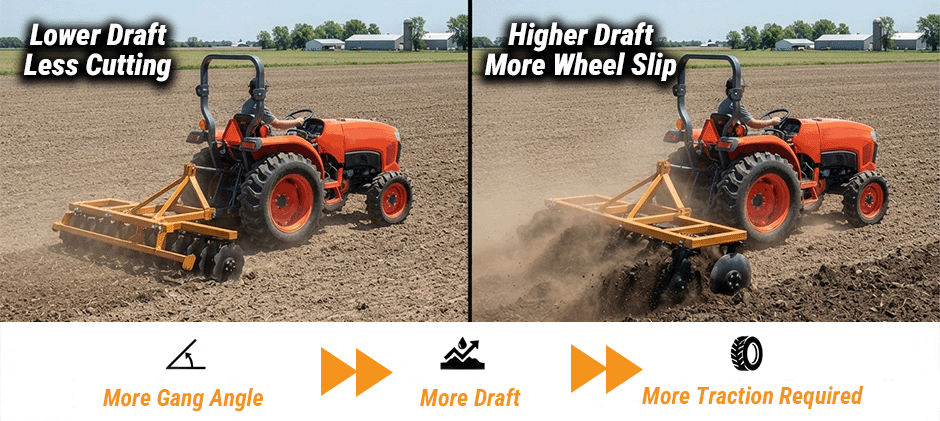
That is why many operators notice the same pattern:
- Small gang angle: the disc rolls, but does not cut deep enough
- More gang angle: the disc starts cutting, but the tractor spins
- More speed: sometimes helps blade action a little, but often increases slip in sand
With a compact tractor disc harrow setup, traction is often the limiting factor, not horsepower alone.
A second issue is tool match. A 5-foot disc sounds reasonable behind a Kubota L-Series tractor, but width is only part of the story. Blade size, blade condition, gang angle, added disc weight, and soil type all change how hard that disc pulls. In loose sandy ground with weeds, the disc may ride on top if it is too light, yet still cause tire slip when the gangs are set too aggressively.
If the disc also has worn disc harrow blades, tired disc bearings, or loose gang bolts, cutting gets worse, and pull becomes less consistent. Fresh disc blades, smooth disc harrow bearings, and tight gang bolt kits can help the implement track and bite more evenly. When replacing these components, sourcing bearing, gear, and shaft parts by category helps ensure the right fit the first time.
How to Add Ballast for Better Traction?
For this kind of job, ballast should be thought of as traction weight first and stability weight second. The goal is to put more effective weight on the rear drive tires without creating a clumsy setup.
Best ballast options for a Kubota L3902
| Ballast Type | What It Helps Most | Main Advantage | Main Tradeoff |
|---|---|---|---|
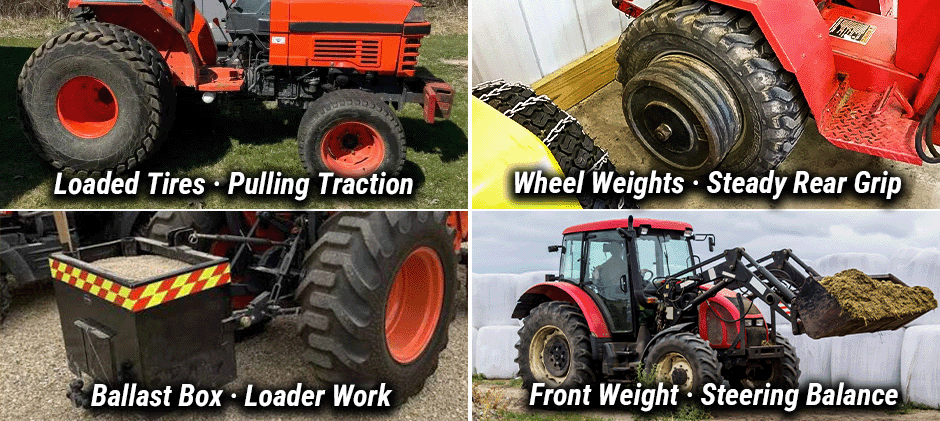
| Loaded Rear Tires | Traction during pulling | Low center of gravity, always there, does not use 3-point | Not quick to remove |
| Wheel Weights | Steady rear grip | Clean, simple, no loss of hitch use | Less leverage than rear-mounted ballast |
| 3 Point Ballast Box | Loader work, extra rear weight | Easy to add or remove, can add a lot of ballast weight | Uses the 3-point hitch |
| Front Weight Or Loader | Front balance and steering | Helps front end stay planted | Does little for rear traction by itself |
For pulling a disc, loaded tires are often the most useful starting point. They add weight directly to the drive wheels, lower the center of gravity, and do not take away your hitch. This matches a common recommendation in the ballast market: fluid-filled rear tires improve safety, balance, and traction while keeping the 3-point free for work.
A ballast box for compact tractor use is different. It is very helpful when using a front-end loader, because rear weight offsets front load and protects the front axle. Many 3-point ballast box models on the market are Category 1 units with up to 800 lb capacity, often with a 2-inch receiver hitch, integrated tool storage, and fill options such as sand, gravel, steel, or concrete. But when a disc harrow is already on the 3-point, a rear ballast box is not an option for that task.
That leads to a practical answer for this question:
If the tractor spins while discing, start here
- Load the rear tires
- Add wheel weights if more grip is still needed
- Reduce disc gang angle slightly
- Check tire pressure and lower it a few psi if within safe range
- Make sure the disc itself is in good shape
This is the most direct fix for Kubota L3902 ballast and traction problems during ground-engaging work.
Loaded Tires vs Ballast Box: What Works Better?
A lot of compact tractor owners ask the same thing: should the money go into fluid in the tires, a tractor ballast box, wheel weights, or front bumper weights? The right answer depends on the job.
When does each ballast type make the most sense?
Loaded Rear Tires
Best for:
- Disc harrow work
- Box blade work
- Rear blade work
- General traction improvement
Why:
- Weight sits right on the drive tires
- No loss of hitch use
- Lower center of gravity than a hanging counterweight
Wheel Weights
Best for:
- Extra traction without changing tractor length
- Operators who want simple, always-on ballast
- Pairing with loaded tires
Why:
- Good for steady traction
- No interference with implements
- Useful when more rear grip is needed but a ballast box for compact tractor work is not possible
3 Point Ballast Box
Best for:
- Front loader work
- Pallet forks
- Moving dirt, gravel, logs, and snow
Why:
- Places weight farther back, so it works efficiently as a counterweight
- Easy to remove
- Some designs double as storage or tool carriers
Hydraulic cylinder seal kits help maintain smooth 3-point hitch response and reliable lift performance. Many product listings in this space push the same idea: a tractor ballast box can protect the front axle, improve traction, and reduce tip risk. Common Cat 1 boxes weigh around 132 lb empty and are built to hold up to 800 lb of fill, depending on material and model.
Front Bumper Weights Or Loader-On
Best for:
- Balancing a rear-heavy setup
- Keeping steering planted
- Transporting rear implements
Why:
- Helps the front stay down and track straight
But there is an important limit. Front weight does not solve rear tire slip the way loaded rear tires do. For a disc in sand, traction usually improves more from rear tire ballast than from front bumper weight.
What Stops a Disc Harrow From Cutting Deep?
Traction is only half the problem. The other half is disc action in loose ground.
A disc harrow not cutting deep in sandy soil usually comes from one or more of these causes:
- The disc is too light for the soil and weed cover
- The gang angle is too flat
- The blades are worn and have lost their edge
- The ground is too loose to resist the blades
- Travel speed is too low for the blades to bite and roll cleanly
- Tire slip is stealing pull before the disc can stay engaged
Sand behaves differently than firm loam. In some fields, a disc just floats unless it has enough downforce and a sharp edge. Then, when the angle is increased enough to bite, the tractor runs out of traction.
That is why this can feel like a no-win setup. But there are ways to make it workable.
Practical ways to improve disc cut in sandy soil
- Set a moderate gang angle
Avoid the flattest setting if weeds are surviving. Avoid the steepest setting if the tractor breaks traction too easily. - Make two lighter passes instead of one aggressive pass
This often works better than asking a compact tractor to pull a hard angle in one shot. - Inspect disc wear parts
Worn disc blades, rough disc bearings, and stretched gang bolts reduce cut quality. - Add traction first, then add bite
Extra rear grip lets you run more angle without instant wheel slip. - Use enough speed for blade action, but not enough to dig holes with wheelspin
In sand, too much throttle often turns into wasted motion.
If the implement is old, replacing harrow blades, gang bearings, and disc axle hardware can make a bigger difference than many expect.
How to Set Up a Disc Harrow for Better Cutting?
A balanced setup matters as much as the ballast choice.
Compact tractor disc harrow setup checklist
Check Rear Tire Ballast
Loaded tires are often the best base setup for pulling tools
Check Tire Pressure
A small drop in pressure can improve the contact patch if still within tire and load limits
Check Gang Angle
Start moderate, then adjust after a short test pass
Check Blade Wear
Smaller worn blades cut less and pull differently
Check Bearing Condition
Bad bearings can make gangs drag instead of roll
Check Tractor Width And Pass Strategy
A narrower effective bite or overlapping passes can reduce draft load
Check Field Moisture
Dry loose sand often gives poorer cut and poorer traction at the same time
Here is a simple field rule for a Kubota L-Series compact tractor:
| Field Symptom | Likely Cause | Best First Fix |
|---|---|---|
| Tractor spins when angle increases | Not enough rear traction | Loaded tires or wheel weights |
| Disc rolls but weeds survive | Angle too flat or blades worn | Increase angle slightly, inspect blades |
| Disc pulls unevenly | Bearing or gang hardware issue | Inspect bearings and gang bolts |
| Tractor steers light with loader work | Not enough rear counterweight | Use a 3-point ballast box |
| Rear tool works fine, but loader feels unsafe | Missing counterweight | Add a ballast box for compact tractor use |
This is where many small farm setups benefit from having more than one ballast solution. For loader work, a 3-point ballast box is useful. For pulling a disc, loaded tires and Kubota tractor wheel weights are often the better answer.
Which Ballast Setup Fits 25 to 40 HP Compact Tractors?
For the common mix of disc, box blade, and rear blade work, the most practical ballast plan usually looks like this:
Best all-around setup
- Loaded rear tires
- Wheel weights if needed
- 3-point ballast box for front loader work
- Front weight only if steering needs help with rear-heavy implements
This gives flexibility across jobs instead of trying to make one ballast style solve everything.
For someone shopping the market, there are many ballast box choices for compact tractors. Product pages commonly show Cat 1 boxes, hitch receivers, and 800 lb rated fill capacity. Some sellers push simple steel boxes. Others push multipurpose racks or suitcase-weight systems. The main decision is not just price. It is whether the ballast must stay on the tractor all the time, whether the 3-point needs to remain free, and whether loader work or drawbar work is the bigger need.
For a Kubota L3902 pulling a 5-foot disc in sandy soil, the priority is rear tire grip. That makes fluid ballast and wheel weights more useful than a hitch-mounted box during the discing job itself.
Final Words
For sandy soil, the best result usually comes from more rear tire grip and a disc setup the tractor can actually pull. That often means loaded tires first, then wheel weights if needed, while a ballast box stays more useful for loader work. If the disc still struggles, it is worth checking wear parts before blaming the tractor. For replacement parts like disc blades, bearings, bolts, and other common service items, FridayParts is a convenient source with broad fitment and fair pricing.
