

When the snow starts falling, there’s no time for guesswork. Starting a snow blower follows the same simple routine every time: check → prime → choke → start → warm up.
This guide is for off‑road equipment owners who rely on their machines to clear driveways, gravel lots, access roads, and job sites. The steps apply to both single‑stage and two‑ or three‑stage snow blowers, helping you get dependable starts in any winter condition.
5 Checks Before You Start the Engine
1. Check the oil level first
Low oil can ruin an engine fast.
- Pull out the dipstick.
- Wipe it clean.
- Put it back in, then pull it out again.
- Make sure the oil level is inside the marked/safe area.
If it’s low, add the correct oil type from your owner’s manual.
2. Ensure the fuel is fresh
Old gas can make starting hard. Gas can go bad in about a month, especially if it has ethanol. Signs of a bad fuel filter or clogged lines often mimic bad gas issues.
- If fuel sat in the tank since last season without a stabilizer, drain it and add fresh gas.
- Use clean fuel from a known-good can, not a can that has been sitting outside.
3. Open the fuel shut-off valve
Most machines have a small valve inline with the fuel hose. Turn the lever so it is parallel to the fuel line (the ON position). If this valve is closed, fuel cannot reach the carburetor, and the engine will not start.
4. Inspect the shear pins and auger
Before starting, make sure the auger area is clear.
- Look for ice chunks, rocks, sticks, or packed snow.
- If the auger is frozen, don’t force it. Forcing it can break shear pins or damage belts when you engage the auger.
Always keep your hands away from the auger housing. Use a clean-out tool if you have one.
5. Insert the safety ignition key
Most snow blowers won’t start without the plastic safety key. If you are experiencing ignition switch problems, ensure the key housing is clean and undamaged.
- Push it in all the way.
- On many machines, it does not “turn”—it just needs to be seated.
(Also check the engine switch is set to ON, if your model has one.)
How to Start a Snow Blower with Electric Start
Connect the extension cord to the machine
Many snow blowers use a 120V plug-in starter.
- Plug the cord into the snow blower first.
- Then plug the cord into a wall outlet.
Use an outdoor-rated extension cord in good condition.
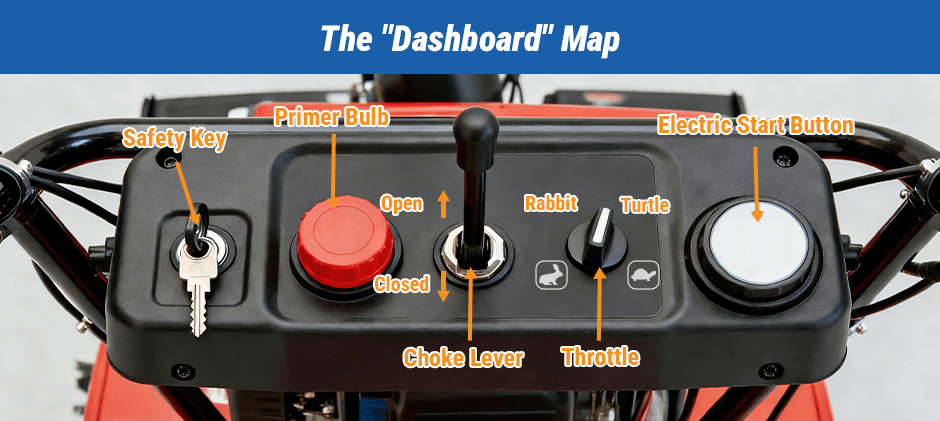
Set the throttle to the “Fast” or “Rabbit” position
Even with an electric starter, the engine needs full throttle to ignite and run properly. Ensure the lever is set to the highest speed.
Prime the engine to introduce fuel
Press the primer bulb 3 to 5 times.
This sends a small amount of fuel into the carburetor to help with cold starting.
If it’s very cold, you may need one or two extra presses. Don’t go crazy—too much can flood the engine.
Set the choke to the “Full” or “Closed” position
A cold engine needs less air and more fuel to start.
- Move the choke to FULL / CLOSED.
Press the start button
Hold the electric start button for no more than 5 seconds at a time. Once the engine starts, unplug the cord from the wall outlet first, then from the machine to prevent the live cord from dropping into the snow. As the engine warms up, slowly move the choke toward RUN / OPEN.
Pro Tip: “Never crank the electric starter for more than 5 seconds. If it doesn’t start, wait 10 seconds to let the starter motor cool down to prevent overheating.”
6 Steps to Manually Start a Snow Blower
1. Set the throttle to the “Fast” or “Rabbit” position
Many engines start best at FAST.
- Set throttle to FAST / RABBIT (if your model has a throttle).
2. Move the choke lever to “Full Choke.”
Put choke on FULL for cold starts.
3. Pump the primer bulb 3 times
Press the primer 3 times.
- If it’s below 0°F (-18°C), you may need 5 presses.
- If you press too many times, the engine can flood.
4. Pull the starter cord until you feel resistance
Pull slowly until you feel it “catch.” This gets the engine in a good spot to start.
5. Pull the cord sharply and rapidly
Pull hard and smooth.
- Don’t let the handle snap back. Guide it back gently so you don’t damage the recoil starter.
6. Adjust the choke as the engine stabilizes
After it starts, the engine may run rough at first.
- Slowly move the choke toward RUN until it runs smoothly.
Are There Differences Between Brands
Yes, mostly in where the controls are and how they are labeled.
The core mechanics of internal combustion are universal, but control layouts vary.
For example:
- On some Troy-Bilt models, the choke and throttle may be on one combined dial.
- On some Husqvarna models, the choke and throttle are separate levers.
If you can’t find a control, check the label near the handlebars or dashboard.
Small engine manufacturers supply most brands.
Many machines use engines from Briggs & Stratton, LCT, or Honda. The parts may look different, but the order is usually the same:
Prime → Choke → Start (button or pull) → Open choke slowly
3 Reasons Your Snow Blower Won’t Start
1. The carburetor is clogged with old fuel
This is one of the most common issues after long storage.
Old fuel can turn into a sticky varnish that clogs small fuel passages inside the carburetor.
When that happens, the engine might crank but not fire — or start briefly and then stall.
2. The spark plug is fouled or not connected properly
Make sure the spark plug wire is firmly attached.
If the engine still won’t start, remove the plug and inspect it:
- Black and dirty? It’s likely fouled and may not spark properly. You can try to clean the spark plug or replace it entirely.
- Wet with fuel? The engine might be flooded. Let the plug dry and pull the starter cord a few times to clear out extra fuel (check your manual for details).
3. The fuel shut‑off valve is closed
Some snow blowers have a small valve near the fuel line that controls flow.
Make sure it’s in the ON position — usually when the lever is parallel to the fuel line.
Summary
As long as you master the proper method and know how to use a snow blower safely, starting your machine can be a repeatable routine.
- Do your quick checks
- Prime the right amount
- Use a full choke for cold starts
- Open the choke slowly as it warms up.
If your machine struggles to start despite following these steps, you may need to replace the carburetor, spark plug, or ignition coil. FridayParts offers a wide selection of high-quality, aftermarket snow blower parts compatible with major brands to keep your equipment running at peak performance all winter long.
