

A Harley rake for a skid steer finish-grades a yard in one pass. By hand, that is hours of work. It is why so many skid steers keep one mounted. There is a catch. Teeth wear. Bearings wear. So does the drive motor. All on a schedule. Miss the early signs and a cheap parts swap becomes a lost week. This guide covers three things. How the attachment works. Which parts fail first. And the upkeep that keeps it grading season after season.
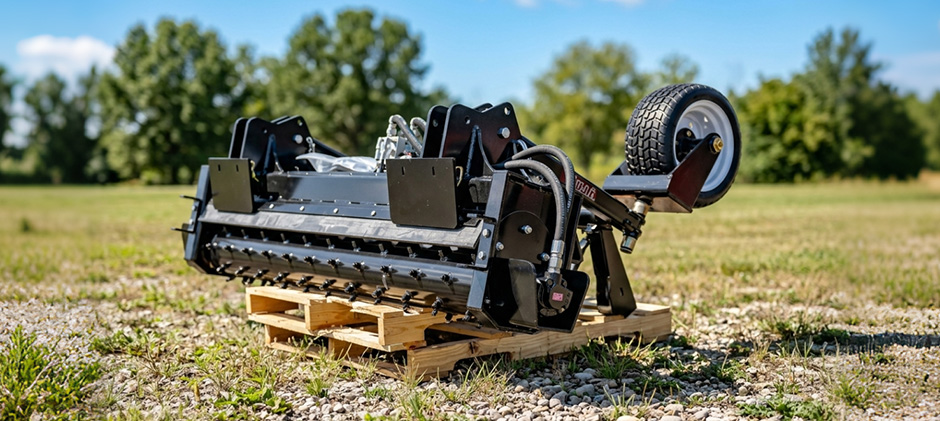
What Is a Harley Rake and What Does It Do?
Go by whatever name you hear on site: power rake, power box rake, or Harley rake. It is the same landscaping tool, bolted to the quick coupler on the front of a skid steer. The drum turns backwards against the way the machine is travelling. That counter-rotation is the whole trick. As it turns, it lifts dirt, cuts into packed ground, and throws rocks and debris off to the side.
You will see this tool on jobs like:
- Final grading before sod or seed
- Reconditioning gravel driveways
- Clearing rocks and roots from a yard
- Smoothing rutted paths and horse arenas
- Breaking up hardpan after demolition work
Set the drum straight and the machine grades flat. Angle it left or right, and it does something else: the teeth gather unwanted material into a line for pickup later. Both outcomes come from the same two actions—angling the teeth into the surface to loosen it, and windrowing, which pushes stones clear of the finish zone.
As for size, most models fall between 48 and 84 inches. Choose by the skid steer’s track or wheel width, so that one pass covers the full lane and no strip of ground is missed.
How a Harley Rake for Skid Steer Works
Power comes from the skid steer’s auxiliary hydraulics. Oil flows through the quick-connect couplers into a motor mounted above the drum, and that motor spins the drum through a chain drive or direct drive setup.
Here is the full chain of motion in order:
- Hydraulic flow leaves your skid steer at the auxiliary ports
- Oil enters the drive motor on top of the attachment frame
- The motor turns a shaft or chain connected to the drum
- The drum rotates against the travel direction at around 200 rpm
- Carbide teeth strike the soil and break it loose
- Angled side plates channel debris into a windrow
Two gauge wheels ride at the front and set how deep the drum cuts. Lift them and the drum drops in deeper. Drop them, and you get a light finishing pass. Most operators start about an inch down, run one pass, then go another inch deeper only if the ground is still rough.
Running direction matters too. Forward operation gives you aggressive cutting for tough ground. Reverse operation smooths the finish and acts more like a leveling blade. Many landscapers do a forward pass for the heavy work, then flip to reverse for the final grade.
Matching the mount is only half the job. Oil flow has to match too. A unit built for 15 to 25 gallons per minute will not behave on a high-flow loader unless you fit a flow restrictor. And if the original drive motor ever gives up, or you move the attachment to a different carrier, matched replacement motors are available.
Parts That Wear Out First on a Harley Rake
Nothing on the attachment wears at the same rate. A few components are ground down within a few hundred hours; the frame and drum body can run for decades. The order in which parts fail is worth knowing—it is what keeps parts spending and shop time down.
Carbide Teeth and Tips
If one part of a rake is going to need replacing, it is usually the carbide tips. They are the components consistently in contact with dirt, roots, and small rocks, and they meet that material once per revolution. After heavy use, the diagnosis is largely visual: edges worn round, carbide chipped away, or a tooth gone from the drum.
Signs your teeth need swapping:
- Finish quality drops even at proper depth
- Drum needs extra passes to break up ground
- Visible chunks missing from the carbide
Most operators change teeth every 300 to 500 hours in abrasive soil. A fresh set of replacement harley rake teeth restores cutting power right away and often costs less than a single day of lost work.
Bearings and Seals
At each end of the shaft, a drum bearing is turning thousands of revolutions per hour. Old seals are what let dust and water in; once inside, they wear the races and eventually give the drum play. The symptoms are hard to miss—a knocking sound, or wobble you can see at the drum ends.
Replace the full bearing kit along with the seals. A fresh bearing paired with worn components will not last its full service life. Keep bearing and seal kits in stock—when a failure comes without warning, the whole attachment is out of action.
Hydraulic Motor and Hoses
The drive motor works under continuous load. As internal parts wear, torque drops and the drum slows or stalls in heavy soil. Heat and sunlight crack hoses, and fittings gradually loosen.
Watch for these red flags:
- Oil weeping around the motor shaft
- Drum stalls under light load
- Pressure spikes on the auxiliary gauge
Gauge Wheels and Tires
Solid rubber wheels develop flat spots, and a hidden rock or curb can bend a spindle. Once a wheel stops spinning freely, it drags, and the cutting depth goes uneven across the pass.
Quick reference table:
| Part | Typical Life | Failure Sign |
|---|---|---|
| Carbide Teeth | 300 to 500 hrs | Chipped tips, poor finish |
| Drum Bearings | 1,000 to 1,500 hrs | Wobble, knocking sound |
| Hydraulic Motor | 2,000+ hrs | Slow drum, oil leaks |
| Hoses and Fittings | 2 to 4 years | Cracks, weeping fluid |
| Gauge Wheel Tires | 1,500+ hrs | Flat spots, bent spindle |
| Side Plates | 3,000+ hrs | Thin edges, cracks |
Signs Your Rake Needs Attention Right Away
One part replaced early is cheaper than three replaced later. The warnings below are the ones that justify stopping the machine that day.
Flat ground that comes out uneven usually means worn teeth or a bent gauge wheel. A washboarded surface after a pass points to one of two things: carbide tips that have lost their shape, or a drum sitting lower on one side.
Vibration through the skid steer cab usually means a bearing problem. A rake that ran smoothly last week and now rattles probably has play in one of the drum bearings. Shut down and look before the shaft itself gets hurt.
Slow drum rotation under light load points to the hydraulic side. Check your oil level first, then the filter. If both are clean, the motor itself may be bypassing internally. Fresh hydraulic hoses and fittings are cheap compared to a seized motor or a contaminated oil tank.
Fluid on the ground after a shift is never normal. Trace the drip back to the hose, fitting, or motor seal. The sooner you catch a weep, the smaller the repair bill.
Any new noise deserves a look too. Chain drive models can develop stretched links or worn sprockets, and the chain tension needs a quick check every 50 hours.
Simple Maintenance That Doubles Attachment Life
Good habits beat big repairs every time. A few minutes before and after each job keep the Harley rake for skid steer working for years instead of seasons.
Daily walk around:
- Grease the drum bearings and pivot points
- Check carbide teeth for cracks or missing tips
- Look under the attachment for fresh oil drops
- Spin the gauge wheels by hand to confirm free rotation
- Inspect hoses for rubs against the frame
Weekly tasks:
- Torque all drum and side plate bolts
- Clean caked mud off the drum and side plates
- Check chain tension on chain drive models
- Verify quick coupler pins lock fully
Store the rake under cover when you can. The hardest thing on a hydraulic hose is often not the work at all—it is sitting outside afterward, under sun and rain. If there is no covered space, block the drum up on wood so the tires are not left holding the machine’s weight on one spot.
The same logic applies to parts. A modest shelf of wear items—fresh teeth, a bearing kit, spare hoses—turns a Monday breakdown into a short repair instead of a lost week. Then a Monday failure costs you an hour instead of the whole week, which matters a lot when a job clock is running.
Clean oil matters as much as any part you can bolt on. Change the loader’s hydraulic filter on the schedule the maker gives you, because dirty oil wears out a drive motor faster than hard work ever will.
Final Words
The math is simple. A few minutes a day. A shelf of common wear parts. Both cost far less than downtime on a grading deadline. FridayParts carries what this attachment goes through most. Teeth. Bearing and seal kits. Hoses. Drive motors. Aftermarket prices that make stocking up easy. Keep it greased, keep it clean, and keep spares close. The rake keeps earning.
