

You turn the key on your lawn tractor, and… nothing. Just dead silence, or worse, a puff of smoke from under the hood. Replacing a faulty ignition switch seems like a quick fix. But you must know the 6-prong wiring rule: B connects to the 12V Battery, S triggers the Starter, M grounds the Magneto to kill the engine, A powers Accessories, and G is the Ground. Mixing up these terminals, especially sending 12V to the M wire, will instantly melt your engine’s magneto coil. Whether you are working on a classic Simplicity 7100 Series or any standard magneto-style garden tractor, this ultimate 6-prong ignition switch wiring diagram guide will show you exactly how to wire, test, and troubleshoot your switch safely.
Understanding the 6 Prong Ignition Switch Wiring Diagram
Understanding the wiring schematics of your ignition switch helps prevent costly repairs when replacing or connecting your ignition switch. Here is a 6-prong ignition switch wiring diagram that fits the Simplicity 7100 Series powered by the Briggs and Stratton engine.
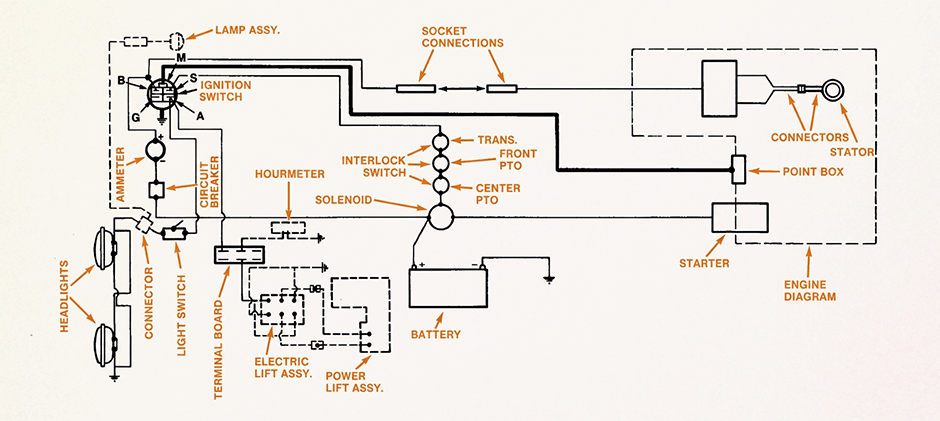
This diagram is the gold standard for 6-prong magneto-style ignition systems. It includes the ignition switch, the starter solenoid, the safety switches, and the charging stator.
What Do the 6 Terminals Stand for?
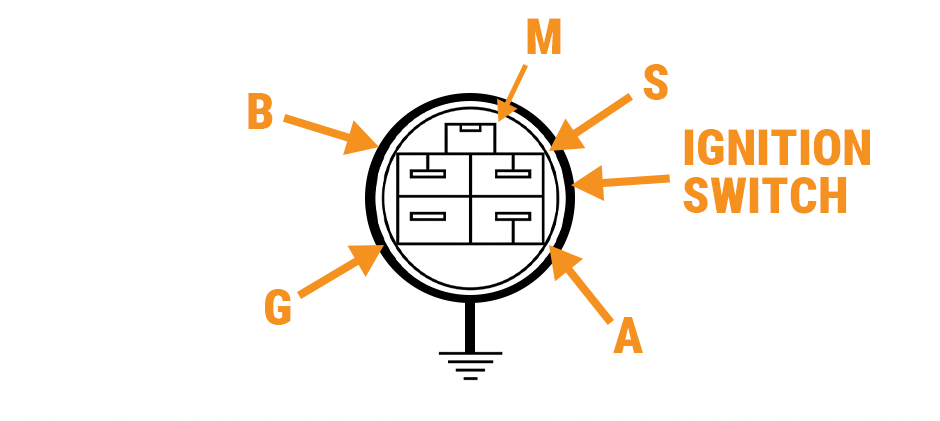
On a standard 6-terminal magneto ignition switch, you’ll find Capital Letters stamped on the plastic next to each terminal. Here is what they stand for and where they connect based on our diagram:
- B (Battery): Connects to the positive (+) battery terminal (via a 20-amp circuit breaker or fuse) to provide constant 12V power.
- S (Starter): Connects to the starter solenoid trigger terminal. This sends 12V to crank the engine when you turn the key to START.
- M (Magneto): Connects to the engine’s magneto/ignition coil. This is a kill wire. It must NEVER receive 12V power.
- A (Accessory): Connects to accessories like headlights, hour meters, or electric lifts. It only receives power when the key is in the RUN position.
- G (Ground): Connects directly to the tractor’s metal frame (ground) to complete the circuit.
On some 6-prong ignition switches, there is often an Optional G. This is a second ground terminal used to ensure a flawless connection for the safety interlock and magneto kill circuits.
CRITICAL WARNING: Magneto vs. Battery Ignition Switches
Before buying a replacement 6-prong ignition switch, you MUST know what type of ignition your engine has.
- Magneto Ignition (Our Diagram): Grounds the ignition coil to kill the spark (OFF = M connected to G).
- Battery Ignition (Automotive style): Sends 12V to an external coil to create spark.
If you install a Battery Ignition Switch on a Magneto engine (like a Briggs & Stratton), turning the key to “RUN” will send 12V battery power directly down the M (Magneto) wire. This will instantly melt your magneto coil under the engine shroud, turning a $15 switch replacement into a $200+ engine teardown. Always buy a switch explicitly labeled “For Magneto Ignition”.
3 Key Ignition Switch Positions: How Does It Work?
An ignition switch is just a rotary gatekeeper. When you turn the key, it connects different terminals inside the switch. The table below shows how the internal connections flow:
| Key Position | Function | Circuit |
|---|---|---|
| 1 | OFF | M-G |
| 2 | ON/RUN | B-L/A |
| 3 | START | B-S |
Let’s break down exactly what is happening behind the dashboard during each of these three key turns:
- OFF (M to G): The M (Magneto) terminal is connected directly to the G (Ground) terminal. Magneto ignition engines (like Briggs & Stratton, Kohler, and Onan) generate their own spark. To shut the engine off, you must ground out the magneto coil. Grounding “kills” the spark, stopping the engine instantly.
- ON/RUN (B to A): The B (Battery) terminal connects to the A (Accessory) terminal. This sends 12V power to your headlights, hour meter, and electric lift. Meanwhile, M is disconnected from G, allowing the engine to run freely.
- START (B to S): The B (Battery) terminal connects to the S (Starter) terminal. This sends temporary 12V power to the starter solenoid, which bridges the heavy battery cable to the starter motor and cranks the engine.
How the Safety Interlock System Fits In?
On certain diagrams, you’ll see the Interlock Module connected to three safety switches.
- Seat Switch: Must be depressed/operator sitting
- Transmission Switch: (Must be in Neutral)
- PTO Switch: Mower deck blades must be disengaged
These switches are wired in a loop. If you are not in neutral, or if the PTO is on, the circuit to the **S (Starter)** terminal is broken. The starter solenoid will get zero power, and the mower will feel completely “dead” when you turn the key.

Step-by-Step Troubleshooting: Mower Won’t Crank?
If you turn the key to “START” and nothing happens, follow this 3-step multimeter test:
- Test Battery Input: Set your multimeter to DC Volts. Probe the wire going to the B terminal. You should see a solid 12.6V. If not, check your battery connections or the 20A circuit breaker.
- Test Starter Output: Probe the S terminal while turning the key to START. If you see 12V at the switch but the starter doesn’t crank, your issue lies further down in the safety switches or the starter solenoid itself.
- Test the Switch Continuity (Bench Test): If you are using a used or salvaged ignition switch, the best insurance is to grab a multimeter and test it before installation. Disconnect the switch completely from the tractor. Switch your multimeter to Continuity Mode (the beep setting) and verify which tabs connect to each other in each key position to ensure they match the table above (e.g., M and G should beep only in the OFF position). Doing this and truly understanding the wiring schematic of the specific tractor you are working on will save you from blown fuses, melted wires, or a ruined magneto!
Conclusion
Ready to wire it up? Don’t guess and risk frying your electrical system. Print out our 6-Prong Ignition Switch Wiring Diagram, grab your multimeter, and perform a quick bench test before plugging everything in. Still having trouble getting your engine to spark? At FridayParts, we provide a vast selection of quality ignition switches for mowers and tractors, as well as engine parts for your Briggs and Stratton. Explore our extensive catalogue today and enjoy optimal equipment performance later.
You Might Also Enjoy
5 Pole Ignition Switch Wiring Diagram
