

The expansion valve is a key part of your air conditioning system. When it breaks, the AC stops cooling and the cab gets extremely hot. You’ll need to fix it right away. Let’s go over the most common bad expansion valve symptoms.
What Does an Expansion Valve Do?
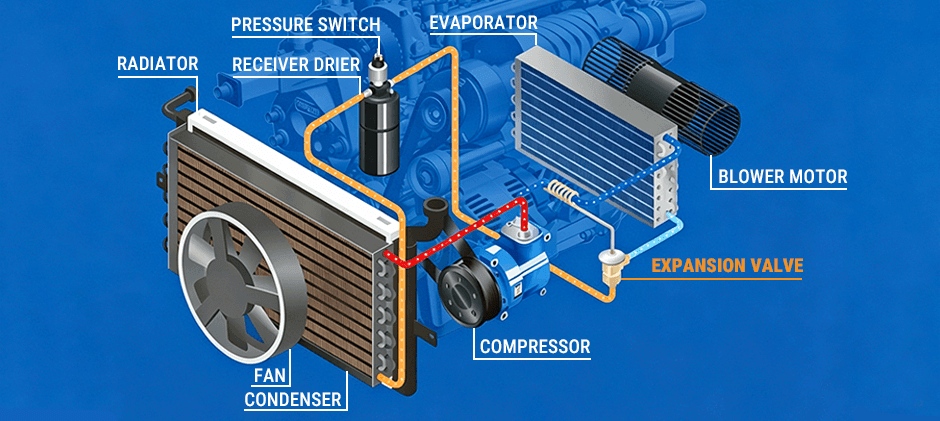
Your AC system uses refrigerant to pull heat out of the cab and vent it outside. This process runs nonstop in a closed loop to keep your equipment’s cab cool.
- Compressor: This is the core of the entire AC system. It takes low-pressure refrigerant gas and compresses it hard, turning it into hot, high-pressure gas.
- Condenser: Sitting right next to the radiator, the condenser cools down the hot refrigerant gas. As it loses heat, the gas turns into high-pressure liquid refrigerant.
- Expansion Valve: The high-pressure liquid then flows into the thermal expansion valve (TXV). You can think of this valve as a precision spray nozzle. It sharply drops the refrigerant’s pressure and controls exactly how much refrigerant flows through. This turns the regular liquid into a super cold, fine mist for cooling.
- Evaporator: The evaporator is hidden inside your cab’s dashboard. The cold refrigerant mist flows through it, and the system fan blows warm cab air over the evaporator fins. The refrigerant soaks up all the heat from the air, which creates the cold air coming out of your AC vents. After absorbing heat, the refrigerant turns back into low-pressure gas.
- Full AC Cycle: The low-pressure gas flows back to the compressor, and the whole cooling cycle starts over again.
The expansion valve’s main job is to control refrigerant flow into the evaporator. It has a small sensing bulb that reads the temperature at the evaporator outlet. The valve opens and closes automatically to keep the evaporator working perfectly — delivering strong cooling performance without freezing up.
Bad Expansion Valve Symptoms
When an expansion valve goes bad, it usually gets stuck either fully open or fully closed. Both issues mess up your AC cooling and cause obvious problems, just with different symptoms.
Warm Air or Weak Cooling
- Stuck closed: Not enough refrigerant flows to the evaporator. Without sufficient refrigerant, the evaporator can’t get cold enough. That’s why the air blowing out of the vents stays warm or only slightly cool.
- Stuck open: Too much refrigerant floods into the evaporator. This throws the whole system off balance and also kills cooling performance, leaving you with warm cabin air.
Frost or Ice on AC Components
- Stuck closed or partially clogged valve: Frost and ice will build up right on the expansion valve and the surrounding refrigerant lines.
- Stuck open valve: Frost usually shows up on the evaporator or the suction line that runs back to the compressor. Excess refrigerant makes these parts way too cold, freezing up the moisture in the air.
Compressor Runs Nonstop or Cycles Repeatedly
- Stuck open valve: The AC can’t cool efficiently, so the compressor will keep running nonstop to try and compensate.
- Stuck closed valve: System pressure drops too low. Most AC systems have a safety switch that shuts off the compressor to prevent damage. When the pressure builds back up, the compressor turns on again. This fast on-and-off behavior is called short cycling.
How to Diagnose a Bad Expansion Valve?
You’ll need an AC manifold gauge set to check for a faulty expansion valve. This tool measures pressure on the AC system’s low (suction) and high (discharge) sides. Always wear safety glasses when working on AC units.
Step 1: Check Static Pressure (Engine Off)
Hook up the gauges with the engine off. Both the low and high side readings should be about the same, matching the outside air temperature. For instance, if it’s 85°F outside, both gauges should read around 85 PSI. If pressure is really low (like 20 PSI), your system has a refrigerant leak.
Step 2: Check Running Pressure
Fire up the engine and turn the AC all the way up. Watch the gauges. For most off-road equipment with a working AC:
- Low side: 25–45 PSI
- High side: 200–275 PSI (numbers change a lot based on outdoor temperature)
Signs of a bad expansion valve:
- Stuck closed: Low side pressure drops way down, even into a vacuum (below 0 PSI). High side will also run low, since refrigerant can’t flow properly to build pressure.
- Stuck open: Low side pressure reads much higher than normal (50–80 PSI). High side may stay normal or creep up, as the compressor works overtime to manage too much refrigerant flow.
What Causes an Expansion Valve to Fail?
Expansion valves take a lot of abuse on off-road machines. Here are the most common reasons they break down:
- Dirt and metal bits: Worn compressors shed tiny metal shavings, and old receiver-driers break down into desiccant dust. These particles float through the AC system and clog the valve’s small inner channels.
- Moisture buildup: If you open up the AC system for repairs and don’t fully vacuum out the air afterward, moisture gets trapped inside. It freezes inside the valve, blocking flow just like a stuck-closed valve.
- Wear and tear over time: The valve has a delicate diaphragm and precision spring. After countless hours of use and nonstop vibration, these parts wear out and can no longer control refrigerant flow properly.
Low Refrigerant or a Stuck Expansion Valve?
It can be tricky to tell if your AC is low on refrigerant or has a stuck-closed expansion valve. Both issues make low and high side pressures read low. You can easily figure out which one it is with a pressure equalization test.
Keep the engine running and AC on, then write down the gauge numbers. Turn off the engine and watch the gauges. The two pressures will slowly balance out to normal static levels.
- If they equalize fast, within 5 to 10 seconds: Nothing is blocked. You’re just low on refrigerant.
- If low side pressure creeps up slowly and high side pressure drops slowly: There’s a blockage. Your expansion valve is clogged or stuck closed.
Conclusion
Hot air from the AC can seriously affect comfort. Knowing the symptoms of a bad expansion valve can help you replace it in time. At FridayParts.com, you can easily find a high-quality replacement expansion valve and get your AC working properly again.
