

When your off-road machine throws SPN 639 FMI 2, the worst part is often the “on-and-off” behavior: it may run fine for an hour, then derate, lose gauges, or log a stack of unrelated faults. This guide helps you pin down what the code really points to, what usually causes it on heavy equipment, and a step-by-step way to fix it without guessing—or replacing the wrong parts.
What Does SPN 639 FMI 2 Mean?
SPN 639 is tied to the Controller Area Network (CAN) communication link—the data highway that lets modules share information (engine control, display, aftertreatment, transmission control, hydraulic control, etc.). FMI 2 means the signal/data is erratic, intermittent, or incorrect.
In plain terms: at least one module is sending unstable messages, or the network can’t carry them cleanly. Because modern off-road machinery relies on CAN data for torque control, emissions management, and safety interlocks, this one code can trigger symptoms that feel “random,” including:
- Intermittent warning lamps and message pop-ups
- Derate or limited power (especially under load)
- Gauges dropping out, display rebooting, or “no comm” messages
- Harsh shifting or abnormal driveline behavior on machines with electronic transmissions
- Multiple “ghost” faults that don’t repeat after a key cycle
Why Does This Code Happen?
Most root causes fall into a few buckets. Thinking in buckets keeps you from chasing every symptom the machine throws at you.
1) Connector and harness issues
Off-road machines live in vibration, dust, washdowns, and temperature swings. That makes CAN connectors and harness routing a frequent failure point.
Common real-world causes:
- Loose connector locks, backed-out pins, or poor terminal tension
- Corrosion or moisture in a sealed connector (often after pressure washing)
- Harness rub-through on a frame edge, boom pivot area, cab mount, or engine bracket
- Stretched harness sections after service work (ties too tight or routing changed)
2) Power supply and ground instability
A CAN network can look “bad” when the network is fine, but a module is browning out or rebooting.
Watch for:
- Weak batteries, poor battery connections, or a failing charging system]
- Ground straps with paint/rust under the lug, or broken ground braid
- Voltage drop during cranking that resets one module but not others
- Shared grounds for multiple modules (one bad ground = many weird faults)
3) Termination and network integrity problems
Most heavy equipment CAN networks rely on two termination resistors (often 120 Ω each) to keep the signal clean. If you lose one, add an extra one, or get partial shorts, the data becomes unstable.
Typical triggers:
- One termination is missing (open circuit)
- Short between CAN High and CAN Low
- Short to ground or power on one leg
- Water intrusion is causing partial shorts that come and go
4) Module behavior
A module that reboots, locks up, or has internal faults can flood the network with bad frames or drop off intermittently.
This can be seen after:
- Jump starts with poor practices
- Welding without proper electrical precautions
- Recent service where connectors were disturbed
- Heat soak near engine/aftertreatment areas
If you need a broader decoder for fault naming and patterns, a quick reference like this SPN/FMI code lookup guide can help you cross-check whether you’re dealing with a network-wide issue or a single subsystem.
How to Fix It?
Below is a practical flow that works well on off-road equipment because it starts with the highest-probability, lowest-cost checks and moves toward deeper electrical testing.
Step 1: Confirm the complaint and capture context
Before touching anything:
- Record when the fault sets (cold start, high load, bumps, after washdown, regen events)
- Note all active + logged codes (not just SPN 639 FMI 2)
- If your tool supports it, save a snapshot / freeze-frame
Pattern clue: If it only happens on rough ground, suspect harness/connector movement. If it happens right after key-on or crank, suspect a voltage drop.
Step 2: Quick visual checks
Focus on CAN-related areas:
- Diagnostic port area and cab harness
- Engine controller connectors and nearby loom
- Frame-to-cab articulation points, boom/arm routing, and clamp points
- Any connector that looks “too clean” (recently opened) or “too wet.”
Look for:
- Green/white corrosion, water marks, bent pins
- Broken seals or missing cavity plugs
- Zip ties cutting into the loom, shiny rub spots, exposed braid
Step 3: Battery, charging, and ground checks
Targets (typical, varies by machine):
- Key-off battery: ~12.6 V on a healthy, charged 12 V system
- Cranking voltage: avoid dropping low enough to reset modules (often <9.6 V is trouble)
- Charging voltage: usually ~13.8–14.5 V on 12 V systems
Also:
- Clean/tighten battery terminals
- Load-check suspect batteries
- Inspect/clean ground straps and main ground points
Step 4: Measure CAN resistance
With the key OFF (and following safe electrical practices for your machine), measure resistance between CAN High and CAN Low at a convenient access point (often the diagnostic connector).
Typical expectation:
- ~60 Ω total for a healthy network with two 120 Ω terminations in parallel
What the reading often means:
- ~120 Ω: one termination missing / open
- Much lower than 60 Ω (e.g., 40 Ω or less): short, water intrusion, or extra termination
- Very high / OL: open circuit in the CAN pair
Step 5: Inspect and “wiggle test” suspect sections
If the code is intermittent, reproduce it:
- Key on, monitor comm status/fault activity
- Gently move harness sections and connectors (don’t yank wires)
- Watch for the code to set, dash to flicker, or comm modules to drop out
This helps you narrow the fault to a physical location.
Step 6: Isolate the noisy module
If resistance checks look normal but SPN 639 FMI 2 persists:
- Unplug modules one at a time per service procedure to see whether network stability returns
- Focus on modules in high-heat or high-moisture zones first (engine bay, aftertreatment area, under-cab)
Important: Don’t “shotgun” modules. A connector/ground issue can mimic a bad module.
Step 7: Address subsystem-related triggers
Sometimes the network issue shows up alongside subsystem warnings that point to where to look.
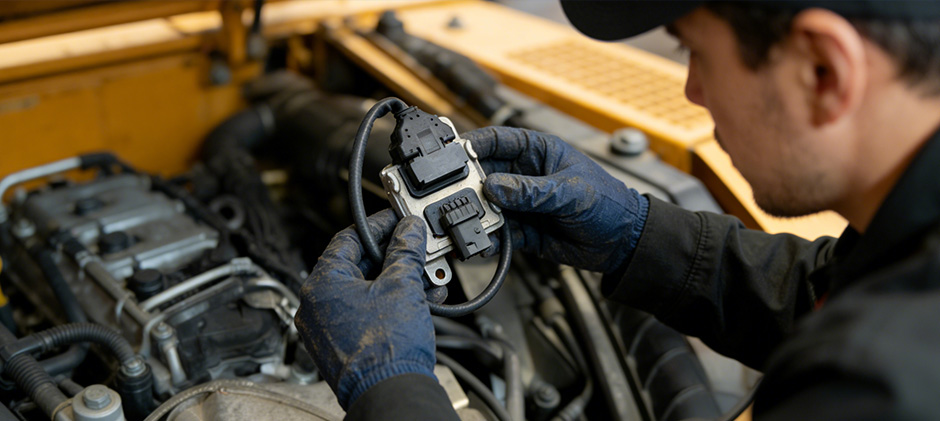
- If the fault clusters around emissions/aftertreatment events (regen requests, derates tied to emissions faults), inspect wiring near the aftertreatment harness runs and sensors. If replacement becomes necessary, matching the correct fitment matters—especially on off-road engines. Here’s the relevant category: NOx sensor.
- If you also see shifting complaints, loss of gear indication, or a transmission controller dropping off the network, inspect the transmission controller power/ground and CAN branch. If the machine truly has drivetrain wear or damage revealed during troubleshooting, you may also be shopping for the correct heavy equipment transmission parts to get the unit back to reliable operation.
How to Avoid SPN 639 FMI 2?
Preventing intermittent CAN faults is mostly about keeping wiring and electrical basics “boring.” The payoff is fewer mystery derates and fewer field calls.
Build these checks into your PM routine
- Connector hygiene: Keep seals intact; replace damaged seals/cavity plugs. If you use dielectric grease, apply it to seals (not as a band-aid on damaged terminals).
- Harness routing: Ensure the loom is supported and not rubbing on sharp edges. Add an abrasion wrap where the harness crosses brackets or frame rails.
- Strain relief: Avoid zip ties that pinch the loom. Use proper clamps at intervals so vibration doesn’t loosen terminals.
- Ground audits: Periodically remove, clean, and re-torque key ground points. A small amount of rust under a lug can cause big comm problems.
- Voltage discipline: Address weak batteries early. Stable power prevents module resets that look like network faults.
Common off-road “chafe zones” worth inspecting
| Machine area | Why it’s risky | What helps |
|---|---|---|
| Articulation joint/frame pivot | Constant movement | Extra slack + abrasion wrap + correct clamps |
| Under-cab harness runs | Vibration + moisture | Secure routing, check grommets and pass-throughs |
| Engine/aftertreatment side | Heat + tight packaging | Heat shielding: Avoid contact with brackets |
| Boom/arm routing (handlers/loaders) | Flexing and pinch points | Proper guides, no over-tight ties |
In Summary
SPN 639 FMI 2 is a CAN communication stability fault—most often caused by connectors, harness damage, weak power/grounds, or network termination problems. Start with voltage and visual checks, confirm CAN resistance, then isolate the problem area with a controlled wiggle test. If you end up replacing related components (like emissions sensors or drivetrain items), we keep a wide inventory of high-quality parts at affordable prices, with broad compatibility across many heavy equipment brands.
