

When P20EE shows up on an off-road machine, the biggest worry isn’t the warning light—it’s the downtime that often follows: power derate, limited RPM, and a job that suddenly can’t get finished. In this guide, we explain what the P20EE code means on SCR-equipped diesel equipment, which machines commonly see it, the most likely causes (from sensors to DEF dosing to exhaust leaks), and a step-by-step fix plan we can follow in the field without wasting money on random parts.
What Does P20EE Code Mean?
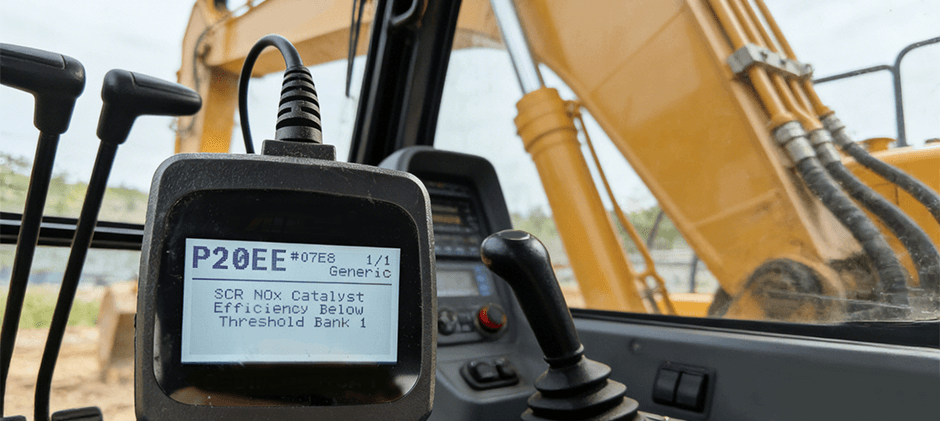
P20EE is commonly defined as “SCR NOx Catalyst Efficiency Below Threshold.” SCR (Selective Catalytic Reduction) is the aftertreatment stage that uses DEF (diesel exhaust fluid) to convert nitrogen oxides (NOx) into less harmful compounds downstream in the exhaust.
Here’s the basic chain of events on off-road diesel machinery:
- The engine produces NOx during combustion.
- Sensors measure exhaust conditions (including NOx and exhaust temperature).
- The system doses DEF into the exhaust at the right time and rate.
- In the SCR catalyst, DEF-derived ammonia reacts with NOx, reducing it.
- The control module compares upstream NOx vs. downstream NOx.
- If the NOx drop is too small for too long, P20EE sets.
Common symptoms of off-road machinery
Symptoms vary by manufacturer and calibration, but these are typical on tractors, loaders, excavators, and similar equipment:
- Engine warning / aftertreatment warning
- Reduced power or RPM limit (derate)
- Higher fuel use for the same work (machine “works harder”)
- Stronger exhaust smell or visible smoke in some cases (not always)
- Other SCR/DEF-related codes are stored alongside P20EE
Related codes you may see with P20EE
Depending on the system, you may also find codes that point you toward a root cause, such as:
- NOx sensor circuit or performance codes
- DEF quality/temperature-related faults
- Reductant dosing or pressure-related faults
Those companion codes matter because P20EE itself is a “result” code—it tells us the SCR outcome is poor, not exactly why.
Which Equipment Would Display This Code?
You’ll see P20EE on off-road diesel equipment that uses SCR/DEF to meet modern emissions requirements (commonly Tier 4 Final / Stage V type systems, depending on market and machine). Examples include:
- Agricultural tractors (including many mid-to-high horsepower units)
- Compact track loaders and skid steers with SCR (varies by model)
- Excavators and wheel loaders with DEF/SCR
- Telehandlers and rough-terrain forklifts
- Some dozers, motor graders, and other earthmoving equipment (model-dependent)
A practical filter is simple:
- If the machine has a DEF tank, an SCR catalyst, and at least one NOx sensor, it can plausibly set P20EE.
And because off-road machines live in dust, vibration, mud, washdowns, and wide temperature swings, the failure patterns are often different than what people expect from road vehicles.
The Possible Causes of P20EE Code
To fix P20EE efficiently, we want to think in systems: sensors → dosing → exhaust integrity → catalyst. Below are the most common causes you see on off-road machinery, with real-world notes on how they fail.
1) Failed or drifting NOx sensor(s)
Most SCR setups use an upstream and downstream NOx sensor to judge conversion efficiency. If either sensor reports wrong values (slow response, biased reading, intermittent dropouts), the control module may conclude the SCR catalyst is inefficient and set P20EE.
Common off-road reasons NOx sensors go bad:
- Heat cycling and vibration fatigue
- Connector corrosion from washdowns
- Harness rubbing on frames or aftertreatment mounts
- Soot/condensation exposure at sensor location
If scan data shows NOx values that are stuck, jumpy, or don’t track load changes, you prioritize testing and often replacement. If you’re sourcing replacements, this is the category to start with: NOx sensors.
2) Exhaust temperature sensor errors (SCR needs the right temperature window)
SCR chemistry depends heavily on exhaust temperature. If the exhaust temperature data is wrong, the system may dose DEF at the wrong time or misjudge the expected efficiency.
What you see in the field:
- The temperature sensor reading doesn’t match the actual exhaust heat (especially after warm-up)
- Readings flatline or spike with vibration
- Wiring damage near hot exhaust sections
If you suspect temperature feedback problems, this is the relevant replacement category: temperature sensors.
3) DEF quality, contamination, or wrong fluid
Even when the DEF tank is full, bad DEF can still cause P20EE because dosing won’t create the correct ammonia availability in the SCR catalyst.
Common issues:
- DEF contaminated with water, dirt, fuel, or other fluids
- Old DEF is stored in heat, leading to degradation
- Crystallization that restricts lines or injector flow
Field clue: white crusty residue around fittings, injector area, or hose connections often points to DEF leaks or crystallization.
4) DEF dosing problems (pump, injector, lines, filters)
The SCR system can only reduce NOx if it doses the correct amount of DEF and atomizes it properly. Problems here are extremely common on off-road equipment because of:
- Plugged DEF injector or poor spray pattern
- Weak DEF pump pressure or unstable flow
- Restricted filters/screens (when equipped)
- Frozen DEF events that damaged components
- Cracked lines or suction leaks
A dosing issue can look exactly like a catalyst problem from the outside—P20EE is the “efficiency is low” result.
5) Exhaust leaks upstream of sensors/catalyst
Leaks can pull in fresh air or change the flow in ways that make sensor readings unreliable. They can also reduce the effective contact time and mixing needed for good SCR conversion.
What to inspect:
- Joints, clamps, bellows, flex sections
- After treatment mounting points (cracks from vibration)
- Soot trails or staining around joints
6) SCR catalyst deterioration or poisoning (less common, but possible)
Catalyst damage can happen, but you treat it as a later-stage diagnosis. Off-road causes may include:
- Long-term operation with poor DEF dosing
- Contamination events (wrong fluid, oil consumption issues)
- Overheating events that stressed the catalyst
Replacing an SCR catalyst is expensive and may be the wrong move if the real fault lies in a sensor, harness, or dosing issue.
Summary Table
How to Fix P20EE Code?
You can get the best results when you follow a repeatable process. The goal is to confirm whether P20EE is caused by bad inputs (sensors), bad dosing (DEF delivery), bad exhaust integrity, or a true catalyst issue.
Step 1: Confirm P20EE and capture freeze-frame + live data
Before clearing anything, you pull:
- Active and stored codes
- Engine load and RPM when the code is set
- Upstream and downstream NOx values (if available)
- Exhaust temperature readings near the SCR
- DEF dosing command/status (if the tool supports it)
This prevents guesswork. If NOx sensors show impossible numbers, you don’t start by replacing the catalyst.
Step 2: Check the basics that cause real SCR efficiency loss
On off-road machines, these basics solve a lot of “mystery” SCR codes:
- Confirm DEF level is adequate (don’t rely only on dash bars)
- Verify DEF is clean and correct (no cloudiness or debris)
- Inspect for DEF leaks and crystallization (white residue)
- Make sure the engine reaches normal operating temp (cold operation can reduce SCR effectiveness)
Transition point: if basics look good, you shift from “fluid” to “signals.”
Step 3: Inspect wiring and connectors (especially near heat and vibration)
Many P20EE cases are caused by wiring faults that only show up under vibration or heat soak.
You inspect:
- NOx sensor connectors for corrosion and loose pins
- Harness routing near exhaust pipes and sharp brackets
- Grounds and power feeds supplying sensor heaters/modules
- Any recent repairs that may have pinched a harness
If you replace sensors, it’s smart to confirm the harness is healthy, or the new part may fail again.
Step 4: Validate NOx sensor behavior
A good approach is to watch live data during:
- Idle to mid-load changes
- Steady operating temperature
- A short working cycle (light load → heavier load)
Red flags:
- Upstream NOx stays flat no matter the load
- Downstream NOx reads nearly identical to upstream at all times
- Downstream NOx is erratic while upstream looks stable (or vice versa)
When sensor data is clearly wrong or intermittent, replacing the affected unit is often the correct fix. You can find options here: NOx sensors.
Step 5: Check exhaust temperature sensor readings
If temperature feedback is wrong, the system may underdose or dose at the wrong times. Compare sensor readings to expected behavior:
- After warm-up, exhaust temps should rise with load
- Sensor readings should not jump unrealistically with bumps
If you need replacements for common off-road applications, here’s the category: temperature sensors.
Step 6: Test DEF dosing: injector function, pressure/flow, and restrictions
If sensors look believable, you move to dosing. Depending on your equipment and tooling, this can include:
- Commanded dosing tests (service tool)
- Visual check of the injector tip for deposits
- Checking for restrictions in lines/filters
- Inspecting pump module operation and leaks
If the machine has chronic DEF crystallization, cleaning and correcting the root cause (storage, contamination, leak paths, poor sealing) matters as much as replacing parts.
Step 7: Check for exhaust leaks and mechanical damage
Repair any leaks upstream of the SCR and sensors. On off-road machinery, fixing one clamp or flex section can completely change NOx readings and resolve P20EE without any emissions component replacement.
Step 8: Clear codes, run a verification cycle, and confirm the code stays gone
After repair:
- Clear codes
- Run the machine through warm-up and a working load range
- Recheck for pending/active P20EE
- Confirm that warnings and derate behavior are gone
If P20EE returns with known-good sensors, correct DEF dosing, and no leaks, then catalyst efficiency may truly be below threshold.
Parts Planning
Once you’ve identified the failing area, it helps to source parts that match off-road duty cycles and fitment needs:
- For SCR feedback issues: NOx sensors and temperature sensors.
- For broader repairs when the root cause is engine condition (oil consumption, fueling problems, or other issues that can affect aftertreatment): engine parts.
- If you’re managing mixed fleets and need a single place to source common heavy equipment categories, you can also browse Cummins parts.
The key is to replace what testing points to—P20EE is expensive when we “parts-cannon” the system.
Conclusion
P20EE means the SCR system’s NOx reduction is below target, and on off-road machinery, it often leads to derating and job delays. We fix it fastest by checking DEF condition and leaks, validating NOx and exhaust temperature sensor data, confirming dosing performance, and repairing exhaust leaks before blaming the SCR catalyst. FridayParts is an aftermarket parts supplier with high-quality products at affordable prices, vast inventory, and wide compatibility for many heavy equipment brands—helping you get back to work with less downtime.
