

When we shop for John Deere X700 parts or compare machines in the same class, “X700” alone is not enough. Small configuration differences—deck size, PTO setup, drive type, steering system version, and serial-number breaks—can change belts, spindles, filters, and even hardware. In this post, we’ll frame the John Deere X700 specs you’ll add (that’s the core of the page), then fill in what owners usually need next: how to keep it running consistently off-road and how to do a clean parts lookup that avoids wrong orders.
About John Deere X700
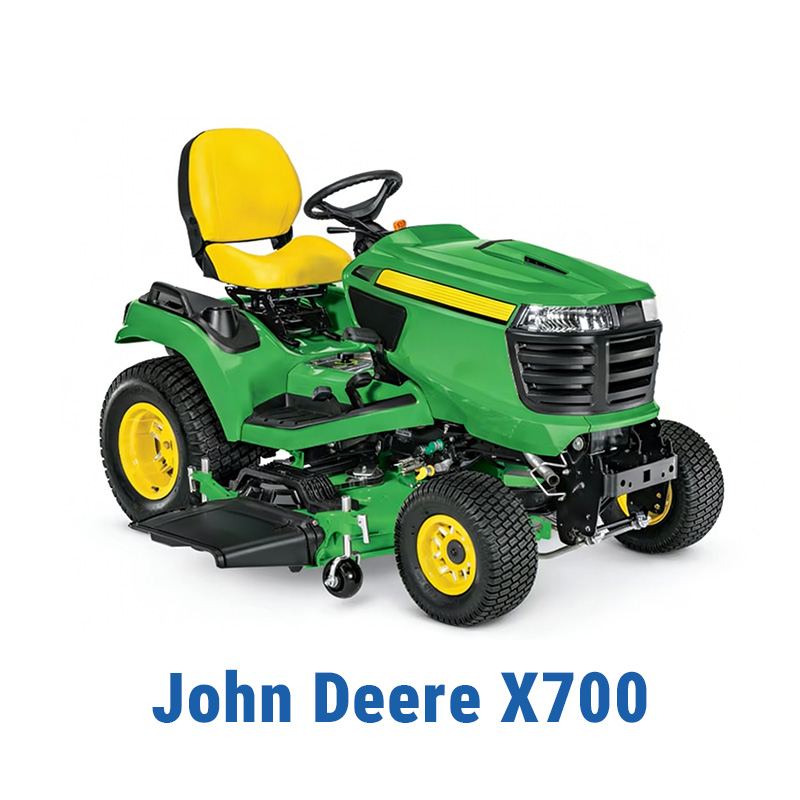
- Garden-tractor platform for off-road property work: suited to turf, gravel drives, light towing, and attachment work when equipped correctly.
- Multiple configurations under one “X700” name: deck size, PTO options, and steering/drive layouts affect both performance and parts fitment.
- Attachment-driven workload: many service issues start at the “power path” (PTO → belt/shaft → deck/spindle) rather than the engine.
- Parts accuracy depends on identifiers: model variant + serial number is the fastest route to the right belt length, spindle style, filter type, and pulleys.
- Best results come from setup: tire pressure, deck leveling, and correct PTO engagement habits often matter as much as raw specs.
Transition: With that context, you can keep maintenance practical—focused on the systems that actually wear in off-road mowing and property use.
John Deere X700 Specs
Engine Detail
| Kawasaki FD671D gasoline 2-cylinder liquid-cooled V-twin |
|
|---|---|
| Displacement | 745 cc 45.5 ci |
| Bore/Stroke | 3.07×3.07 inches 78 x 78 mm |
| Power (gross) | 23 hp 17.2 kW |
| Fuel system | carburetor |
| Air cleaner | paper element |
| Compression | 8.0:1 |
| Idle RPM | 1600-3550 |
| Starter volts | 12 |
| Starter power | 1.1 hp 0.8 kW |
| Oil capacity | 1.9 qts 1.8 L |
| Coolant capacity | 4.2 qts 4.0 L |
Transmission
| Transmission | Tuff Torq K92 |
|---|---|
| Type | shaft-driven hydrostatic |
| Gears | infinite forward and reverse |
| Oil capacity | 7 qts 6.6 L |
| Hydrostatic transmission with Twin Touch foot pedals and dashboard-mounted cruise control standard. | – |
John Deere X700 Tires
| Ag rear | 26×12.00-12 |
|---|---|
| Lawn/turf front | 18×8.5-8 |
| Lawn/turf rear | 26×12-12 |
Dimensions
| Wheelbase | 54.5 inches 138 cm |
|---|---|
| Length | 78.8 inches 200 cm |
| Width | 46.8 inches 118 cm |
| Height | 47 inches 119 cm |
| Weight | 840 lbs* 381 kg |
Hydraulics
| Pressure | 924 psi 63.7 bar |
|---|---|
| Valves | 2 Opt |
| Total flow | 4.5 gpm 17.0 lpm |
Source from: www.tractordata.com
Related John Deere X700 Parts
Maintenance Tips for John Deere X700
1) Build a “parts-ready” baseline before anything fails
Before you chase symptoms, you should set up a simple record that makes future John Deere X700 parts orders faster and more accurate:
- Model and full serial number (from the machine ID plate)
- Deck model/size and any attachment model numbers
- Current belt routing photo (taken when the machine is working correctly)
- Last service date/hours for oil, air filter, fuel filter (if equipped), and spark plugs (if applicable)
This is not paperwork for paperwork’s sake—belts, blades, spindles, and idlers often have multiple valid options depending on serial breaks and deck variants.
2) Keep the “cut system” efficient
For X700 owners, the deck is usually the highest-wear assembly. If the cut quality drops or vibration shows up, check in this order:
- Blade condition and balance (dull or bent blades can mimic spindle failure)
- Deck leveling and pitch (a small setup error can look like power loss)
- Belt condition and tension (glazing/cracks = slipping and heat)
- Idler pulleys and bearings (noise or wobble under load)
- Spindles (play, heat, grease, condition if serviceable)
A clean deck (no packed grass) also reduces belt heat and spindle load—simple, but it changes how long parts last.
3) Make airflow and cooling non-negotiable in dusty off-road work
Off-road property work kicks up fines, chaff, and dry grass. You should treat intake and cooling maintenance as “power maintenance”:
- Clean intake screens and cooling fins regularly (gently—avoid bending fins)
- Replace or service the air filter when restriction shows up (don’t wait for black smoke or bogging)
- Watch for debris buildup around the engine compartment after heavy mowing
4) Grease and steering checks: small play becomes expensive play
If your configuration uses grease points on steering linkages or deck components, keep them on a schedule from the operator manual. You also look for:
- Torn dust boots
- Loose fasteners after rough ground use
- Early signs of steering free play (often a bushing/joint issue before it becomes a larger repair)
Common Issues & Solutions
Issue A: Uneven cut, scalping, or poor stripe consistency
What it usually is: setup, blade condition, or deck hardware—not an engine problem.
What you do:
- Confirm tire pressures are even (uneven tires = uneven deck)
- Verify deck level and pitch per the operator manual
- Inspect blades for bend and balance
- Check deck hangers and anti-scalp wheels for looseness or wear
Issue B: Vibration, rattling, or a “growl” that changes with PTO on/off
What it usually is: rotating parts in the deck drive path.
Fast isolation steps:
- If vibration only happens with PTO engaged, inspect the belt, idlers, and spindle bearings first
- Spin idlers by hand (with engine off and safe access); feel for roughness or side play
- Check blade hardware torque and look for impact damage
Common parts involved: belts, idler pulleys, spindles, blades, and related fasteners—ordered correctly only when the deck model and serial are confirmed.
Issue C: PTO won’t engage, or it slips under load
What it usually is: belt wear, tension system issues, or an electrical/control input, depending on configuration.
What you check:
- Belt routing and wear pattern (shiny/glazed = slip/heat)
- Idler arm movement and spring condition
- Wiring/connectors at the PTO switch or clutch (if equipped), looking for corrosion or loose pins
- Safety interlocks (seat switch, brake switch) if engagement is blocked
Issue D: Hard start, no start, or intermittent cranking
What it usually is: battery/connection issues or safety circuit interruptions.
What you check first :
- Battery state of charge and load test results
- Battery terminals and ground connection (clean, tight)
- Safety switches and related connectors
- Starter relay/solenoid signals (basic voltage checks)
Avoid ordering starters early—many “starter failures” are caused by voltage drops.
Conclusion
Once you add the full John Deere X700 specs section, the fastest path to reliable ownership is disciplined maintenance and an accurate John Deere X700 parts lookup. We get better results by matching model variant and serial number first, then confirming deck/attachment details before ordering wear parts like belts, spindles, and idlers. As an aftermarket parts supplier, we focus on high-quality products at affordable prices, a vast inventory, and wide compatibility for many heavy equipment brands.
