

Off-road work is where small spec differences become real downtime: a hose routing change, a connector revision, or a filter head update can turn a “simple” parts order into a week of delays. In this guide, we’ll frame what owners actually need around John Deere 3025E specs (you’ll add the full specs block) and show how we do reliable John Deere tractor parts lookup for maintenance and repairs—without guessing.
About the John Deere 3025E
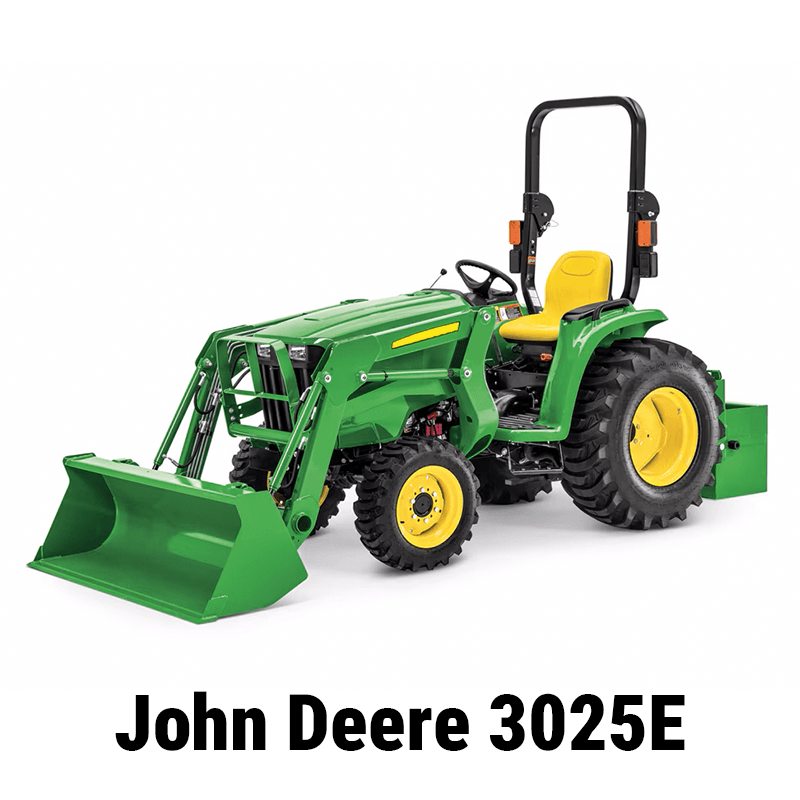
- Compact utility size that fits tight off-road work areas (gates, barns, tree lines)
- 4WD traction emphasis for soft ground, slopes, and loader pushing
- Hydro-style control approach that favors frequent forward/reverse cycles
- Most productive when ballast, tire choice, and implement match are planned together
- Parts accuracy depends on serial/PIN + configuration, not just “3025E” on the hood
Transition: Once you know where the tractor fits, the next step is keeping it consistent day-to-day—because most “power loss” or “weak hydraulics” complaints are really maintenance or setup issues that show up under load.
John Deere 3025E Specs
Engine Detail
| Yanmar 3TNV88F diesel 3-cylinder liquid-cooled |
|
|---|---|
| Displacement | 100.2 ci 1.6 L |
| Bore/Stroke | 3.46×3.54 inches 88 x 90 mm |
| Emissions | Tier 4 |
| Power (gross) | 24.4 hp 18.2 kW |
| Fuel system | high-pressure common rail direct injection |
| Air cleaner | dual dry element |
| Compression | 19.1:1 |
| Rated RPM | 2400 |
| Idle RPM | 950-2550 |
| Starter | electric |
| Starter volts | 12 |
| Starter power | 1.9 hp 1.4 kW |
| Oil capacity | 4.7 qts 4.4 L |
| Coolant capacity | 5.2 qts 4.9 L |
John Deere 3025E Power
| Engine (gross) | 24.4 hp 18.2 kW |
|---|---|
| PTO (claimed) | 17.4 hp* 13.0 kW |
Hydraulics
| Type | open center |
|---|---|
| Pressure | 2500 psi 172.4 bar |
| Valves | 0 to 2 |
| Pump flow | 5.3 gpm 20.1 lpm |
| Total flow | 9.3 gpm 35.2 lpm |
| Steering flow | 4 gpm 15.1 lpm |
3025E Serial Numbers
| 2013 | 3025ExDHxxxxxx |
|---|---|
| 2014 | 3025ExEHxxxxxx |
| 2015 | 3025ExFHxxxxxx |
| 2016 | 3025ExxGxxxxxx |
| 2017 | 3025ExxHxxxxxx |
| 2018 | 3025ExxJxxxxxx |
| 2019 | 3025ExxKxxxxxx |
| 2020 | 3025ExxLxxxxxx |
| 2021 | 3025ExxNxxxxxx |
| 2022 | 3025ExxPxxxxxx |
Source from: www.tractordata.com
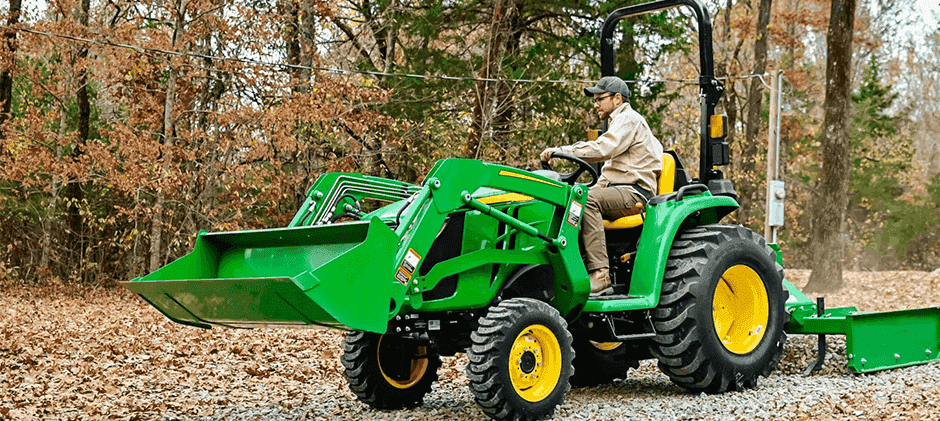
John Deere 3025E Parts Lookup
Operating and Maintenance Tips
Specs tell us the limits; setup decides whether you reach them safely. For loader work, you aim to control wheelspin and front-end overload by using proper ballast (rear implement, ballast box, or loaded tires if appropriate) and keeping tire pressure matched to the job. This protects steering components, front axle loads, and reduces “light rear end” moments that waste time and fuel.
Treat filtration as a performance part
On compact tractors working in dust, chaff, and mulch, restriction is a common cause of “it feels weak.” We recommend a simple approach:
- Track service hours and the date of the last engine oil, fuel, and air filter service (write it down).
- If power drops, check air intake restriction and fuel delivery basics before buying higher-cost components.
- Use filters that match the correct application and serial break—small differences can matter.
Cooling system habits that prevent most overheating complaints
Many overheating cases in mowing and brush work come from blocked screens and packed radiator fins. You should keep it basic: clean gently and often, and avoid bending fins. If the tractor only runs hot under debris-heavy work, that pattern usually points to airflow, not a failed water pump.
Parts lookup discipline
Before ordering John Deere tractor parts, you should collect the same identifiers every time. This reduces “looks the same” mistakes—especially when mid-production changes exist.
Common Issues & Solutions
1) Slow crank or no start
Typical causes: weak battery, corroded terminals, poor ground, safety interlock not satisfied.
What you check first:
- Battery condition under load (not just open-circuit voltage)
- Clean/tight terminals and chassis ground
- Seat/PTO/range interlocks (if the start circuit depends on them)
2) Starts, but feels low on power under load
Typical causes: restricted air filter, fuel restriction, contaminated fuel, or operating below the RPM range needed for hydraulic demand.
What you check first:
- Air filter condition and intake sealing (dust leaks are costly)
- Fuel filter condition and any water contamination
- Whether the issue appears only at high load (mowing uphill, pushing into piles), which points to a restriction or setup
3) “Lazy” hydraulics or weak loader response
Typical causes: low fluid, wrong/old fluid, clogged hydraulic filter, suction-side air leak, or overheating under long cycles.
What you check first:
- Fluid level and appearance (foamy can suggest aeration; milky can suggest water)
- Filter service history
- Hose/clamp condition on the suction side (small seepage can pull air without obvious dripping)
4) Overheating during mowing or brush cutting
Typical causes: airflow blockage at screens/fins, coolant level/cap issues, belt/fan problems.
What you check first:
- Screens and radiator fins for packed debris
- Coolant level and cap condition
- Belt tension and fan integrity
Conclusion
Good specs help us choose the right implements and set expectations, but reliable uptime comes from correct identification and basic system checks. For the John Deere 3025E, we reduce wrong orders by using the tractor’s serial/PIN, confirming configuration (loader, hydraulics, tires), and matching parts by the correct catalog range. As an aftermarket parts supplier, we support owners with high-quality products at affordable prices, a vast inventory, and wide compatibility across many heavy equipment brands.
