

Choosing Cellulose vs. Synthetic Oil Filters is a critical decision for any heavy equipment owner. While the basic differences seem simple, the debate among industry experts is surprisingly complex. This guide cuts through the noise, addresses the technical arguments you might see in enthusiast forums, and provides a clear, authoritative recommendation for your off-road machinery.
What Are the 2 Main Types of Oil Filters?
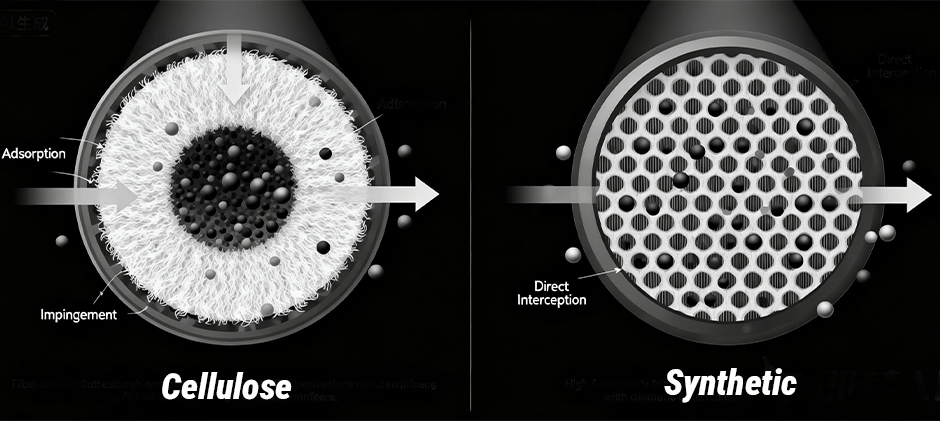
The performance of an oil filter begins with its core material, known as the filter media. This is what separates damaging contaminants from your engine’s lifeblood.
Cellulose Media: The Proven Standard
Cellulose oil filters are made from natural wood pulp fibers. These filters have been the industry standard for decades, offering reliable protection for engines running on conventional oil and following standard maintenance schedules. They are a cost-effective and proven solution for many applications.
Synthetic Media: The High-Performance Engineer
Synthetic oil filters are constructed from engineered materials like fiberglass and polyester. The fibers are incredibly fine and uniform, allowing for a media design that prioritizes higher efficiency, greater capacity, and superior durability, especially under the extreme conditions faced by heavy machinery.
Why the Filter Media Choice Is Debated
While synthetic media is generally seen as the premium option, there is an ongoing technical discussion about how each media type actually traps particles. Understanding this debate shows why there isn’t a “one-size-fits-all” answer.
The Argument for Cellulose: Adsorption and Impingement
Some experts argue that cellulose has unique advantages. The theory is that its “fluffy,” complex fiber structure is better at trapping contaminants through two processes:
- Adsorption: Where contaminants stick to the surface of the fibers.
- Impingement: Where particles, due to their inertia, embed themselves into the fibers as the oil changes direction.
The claim is that this “depth-loading” prevents the filter’s smallest pores from clogging quickly. As one industry council member noted, this could mean it “can remove more contaminants… without plugging pore spaces.”
The Counter-Argument: Real-World Capacity and Flow
However, the overwhelming consensus among filtration specialists and experienced mechanics points in another direction.
“While the theory of adsorption is valid, real-world data consistently show that, per square inch, synthetic media has a much higher dirt-holding capacity and maintains better flow as it loads up.”
Full synthetic filters are engineered for extended service intervals for a reason. Their structure provides more pathways for oil to flow, preventing the pressure drop that occurs when a cellulose filter becomes saturated. This is why synthetic filters are universally rated for longer lifespans (10,000-15,000 miles or 500+ hours) compared to their cellulose counterparts.
When Cellulose Has a Unique Advantage: Absorbing Contaminants
One point where experts agree is cellulose’s ability to absorb certain types of contaminants that synthetic media cannot. Much like a paper towel absorbs water, cellulose media can absorb small amounts of moisture and sludge from the oil. For older engines or those prone to condensation, this can be a legitimate benefit.
Cellulose vs. Synthetic Oil Filters: How to Choose
Your choice should be a strategic decision based on your equipment, your oil, and your operation’s goals.
3 Reasons to Choose a Cellulose Filter
- You Use Conventional Oil. A high-quality cellulose filter is the perfect, cost-effective partner for mineral-based oils and standard service intervals.
- Your Engine Deals with Moisture. If you have an older machine or operate in a way that causes condensation, the absorptive properties of cellulose can be beneficial.
- Your Primary Goal is Budget-Friendly Maintenance. For routine work in non-severe conditions, cellulose filters provide dependable protection at a lower upfront cost.
3 Reasons to Choose a Synthetic Filter
- You Use Full Synthetic Oil. To get the full value from expensive, long-life synthetic oil, you need a filter that can last the entire service interval without compromising performance.
- Your Equipment Works in Harsh Conditions. For machinery in dusty environments, extreme temperatures, or under constant heavy load, a synthetic filter’s superior capacity and durability provide critical engine protection.
- You Want to Maximize Uptime and ROI. The higher initial cost of a synthetic filter is often offset by longer service intervals, which means reduced labor costs, less downtime, and ultimately, a more productive and profitable operation.
The Final Verdict
The “cellulose vs. synthetic oil filter” discussion is nuanced, but for the modern off-road machinery owner, the conclusion is clear. Your filter choice should align with your maintenance strategy. While a quality cellulose filter is an excellent tool for standard use, a synthetic filter is the superior choice for protecting high-investment engines running synthetic oil, especially in demanding environments.
At FridayParts, we understand that protecting your engine is protecting your livelihood. We offer a complete range of both dependable cellulose and high-performance synthetic filters to match your specific needs. Explore our complete collection of oil filters for heavy equipment to find the authoritative choice for your machine today.
