

A fan clutch is a key part of your engine’s cooling system. It helps control how fast the fan spins based on engine temperature. When it works correctly, it keeps your engine cool without wasting power.
If it starts to fail, your engine may run too hot, too loud, or lose some performance. This simple guide explains how it works, what happens when it fails, and how to diagnose it — using plain language and basic tools.
What Is the Fan Clutch?
It connects the engine’s pulley to the cooling fan. When the engine gets hot, the clutch engages, making the fan spin faster to draw in more air through the radiator. When the engine cools, the clutch releases, letting the fan spin more slowly.
This automatic control helps maintain a steady temperature and saves engine power. Fan clutches are common in off‑road machines, trucks, and older vehicles that use belt‑driven cooling systems.
How Does the Fan Clutch Work?
Older belt‑driven fans used to spin at the same speed as the water pump pulley. But modern viscous (fluid‑filled) fan clutches can “slip,” allowing the fan to spin at variable speeds.
Inside the clutch, a bimetal spring reacts to air temperature coming through the radiator.
- When cold, it keeps the clutch partly disengaged, letting the fan freewheel.
- When hot, it engages the clutch by controlling silicone fluid inside, locking the fan closer to pulley speed.
Some newer models are electronically controlled — the computer activates the clutch based on temperature sensors.
How To Tell if the Fan Clutch Is Bad
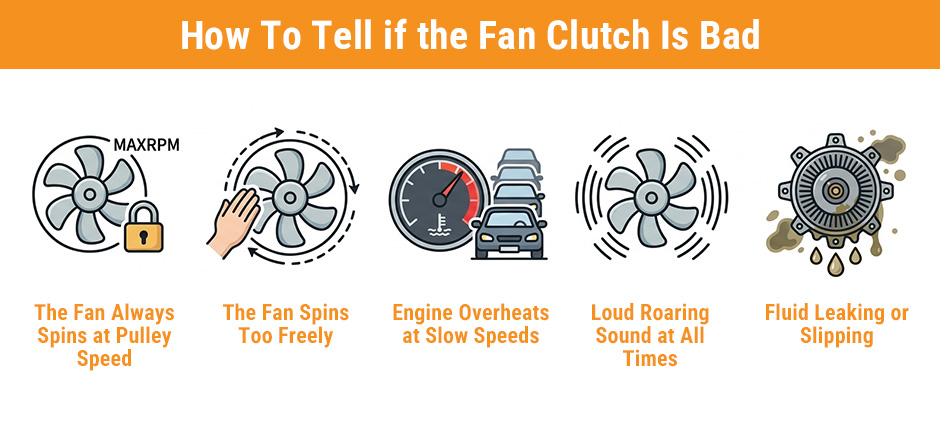
It can fail in several ways:
It might stay locked all the time, never engage at all, or spin inconsistently. Below are the most common symptoms.
1. The Fan Always Spins at Pulley Speed
If your fan spins at full pulley speed no matter the temperature, the clutch may be seized in the on position.
With the engine off, try turning the fan by hand.
- If it’s extremely hard to turn or feels stuck solid, that’s a clear sign it’s locked up.
When this happens, your engine won’t usually overheat, but:
- Fuel consumption might go up.
- Power may feel weaker.
- The engine could take longer to warm up in cold weather.
This is because the fan never stops drawing power, even when it’s not needed.
2. The Fan Spins Too Freely
If you can spin the fan easily and it keeps spinning for several turns after a light push, the clutch is worn out or not engaging.
This is called a freewheeling failure — the clutch no longer transfers enough power from the pulley to the fan.
When this happens, the engine might:
- Overheat in traffic, while idling, or under a heavy load
- Runs fine at highway speeds (since natural airflow cools it there)
3. Engine Overheats at Slow Speeds
When your fan clutch doesn’t engage, the fan can’t spin fast enough to pull in cooling air.
You’ll usually see the temperature gauge climb when idling or working at low speed, but drop during driving.
If you notice this, check your fan clutch before assuming the radiator or thermostat is bad.
4. Loud Roaring Sound at All Times
If the fan makes a steady, loud roar even when the engine is cold or at cruising speed, the clutch is likely locked up.
Normally, a healthy clutch will make noise only when first starting (cold) or when the engine is hot.
Constant loud airflow means it’s stuck in the “engaged” position.
5. Fluid Leaking or Slipping
Fan clutches are filled with silicone fluid.
If the internal seal breaks, the fluid leaks out, often leaving oily dust on the clutch face.
Once this happens, the clutch can’t operate correctly.
This usually results in either a stuck or free‑spinning fan, depending on the type of failure.
How To Check a Fan Clutch (Simple Tests)
You can test your clutch easily without special tools:
1. Spin Test (engine off, cool) — Grab a fan blade and spin it.
- Slight resistance is normal.
- Too easy or too stiff both mean failure.
2. Wiggle Test — Hold a blade top and bottom, and gently pull it forward and back.
- Any looseness or “clunk” means a worn bearing — replace the clutch.
3. Noise / Airflow Check (engine running) —
- On a cold start, you should hear a whoosh for about a minute, then it should quiet down.
- When hot, it should engage again, making more airflow noise.
Why Fan Clutches Fail
Fan clutches work under heavy vibration and heat cycles. Common causes include:
- Seal failure — Silicone fluid leaks out over time.
- Bearing wear — Continuous spinning causes internal wear and wobble.
- Spring or valve failure — The temperature‑controlled valve can jam or break.
Off‑road use speeds up wear because of dust, mud, and constant temperature swings.
When To Replace the Fan Clutch
Replace the fan clutch if you notice these issues:
- Constant roaring fan noise
- Overheating at idle or low speed
- Leaking fluid or visible wobble
- Fan spins freely or is completely stuck
It’s usually easy to replace using standard tools — especially on trucks, loaders, or skid steers that share parts compatible with aftermarket parts and similar heavy‑duty systems.
Final Takeaway
A bad fan clutch won’t always cause immediate overheating — sometimes it just robs power or fuel economy. But ignoring it may lead to bigger cooling issues down the road.
Regular inspection helps you catch wear early. If your fan spins too freely, never disengages, or leaks fluid, it’s time for a new clutch. When it’s time for a replacement, trust FridayParts to provide high-quality, durable fan clutches designed for the tough demands of your equipment. Explore our selection and find the right part to restore your engine’s cooling performance today.
