

Ever hit a wall trying to figure out whether your tractor is 4WD or MFWD? What’s the heck difference between the two systems? You may be stuck in this situation where you’re searching for a front axle part, a driveshaft component or a front differential seal for your tractor. You’re not alone. These two terms get used all the time interchangeably. The confusion can lead to ordering the wrong parts or misdiagnosing a drivetrain problem. In this guide, we’ll cut through the terminology and give you a clear understanding of how each system works, how to identify which one your tractor has, what goes wrong and how to make sure you’re buying the right parts.
What Does MFWD Mean on A Tractor?
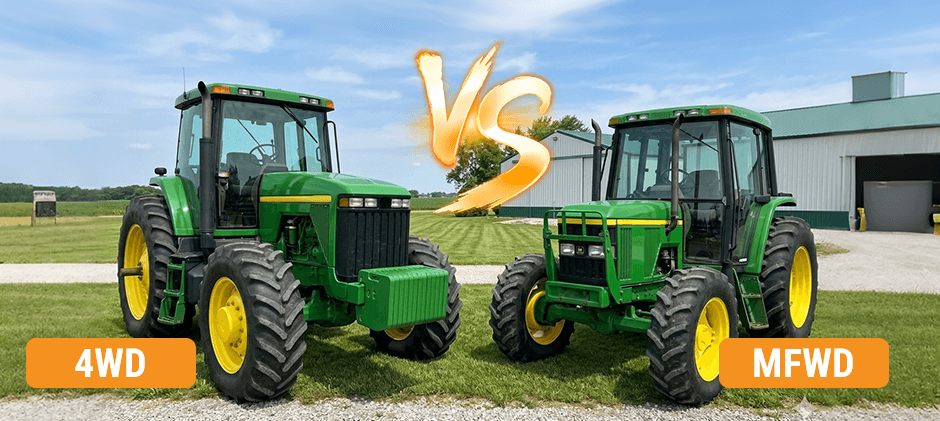
MFWD stands for mechanical front-wheel drive—and yes, it sounds like it should mean the same as 4WD, but it doesn’t. The real difference is that MFWD doesn’t run all four wheels all the time. Under normal conditions, your rear wheels are doing the work and the front axle just comes along for the ride. When you actually need that extra grip, say you’re pushing through a muddy field, climbing a slope, or working with a loaded front loader, you flip the MFWD switch or lever and the front wheels join in. A clutch pack inside the front axle housing locks up, power starts flowing to the front, and you’ve got four wheels pulling. Flip the switch back, and the front axle goes passive again. That’s really all there is to it. You might see this system labeled as Front-Wheel Assist (FWA) or Mechanical Front-Drive Axle (MFDA) depending on the brands you’re dealing with. That’s really common on most compact and mid-size tractors with 25 to 150 horsepower.
What Does 4WD Mean on A Tractor?
When most tractorers say 4WD tractor, they are referring to large articulated machines, like high-horsepower John Deere or Case IH row-crop tractors with four roughly equal-sized tires and a frame that bends in the middle to steer. On a true 4WD tractor, power is delivered to all four wheels continuously through a central drivetrain that runs front to rear. Both axles are always engaged and there is no switch to turn the front drive on or off. True 4WD tractors are built for maximum pulling power in the toughest conditions, such as deep mud, heavy tillage and steep terrain. Because the front axle is always under load, wear happens consistently across the whole drivetrain. They are heavier, more mechanically complex, and generally built in a larger horsepower range, typically 150 HP and above.
4WD vs MFWD Tractor: Which System Do I Have?
Not sure which system you’re working with? Here are the fastest ways to tell.
- Check the front axle area. An MFWD tractor has a visible front drive shaft running from the transmission housing forward to the front differential. A 4WD tractor has a heavier, center-pivot frame rather than a conventional front axle. A 2WD tractor has no front drive shaft at all.
- Look at the operator’s controls. MFWD tractors have a dedicated engagement switch, button, or lever on the dashboard or console. If yours has a front drive engage control, it’s an MFWD. True 4WD tractors don’t have this because the front axle is always on.
- Compare front and rear tire size. An MFWD tractor almost has noticeably smaller front tires than rear tires, while a true 4WD tractor typically runs on four tires of close size.
- Check your operator’s manual or serial number plate. The tractor’s model designation will usually include MFWD, MFD, or FWA (Front Wheel Assist) if applicable.
Side-by-Side Comparison of 4WD vs MFWD
The table below shows the key differences between 4WD and MFWD tractors. Remember, these are general trends; actual performance varies based on factors such as specific tractor model, terrain, and operational demands. Always consult individual tractor specifications for accurate comparisons.
| Features | 4WD Tractor | MFWD Tractor |
|---|---|---|
| Front axle engagement | Constant | Selectable (on/off) |
| Tire setup | Four similar-sized tires | Smaller front, larger rear |
| Steering method | Articulated center-pivot frame | Front axle turns |
| Common horsepower range | 150 HP and above | 25–150 HP |
| Front drivetrain wear pattern | Even across full drivetrain | Concentrated at engagement points |
| Traction | Superior in extremely challenging conditions | Excellent in most conditions; may require additional weight in extreme situations |
| Fuel efficiency | Generally lower | Generally higher |
| Maneuverability | Potentially less nimble | Generally better |
| Soil compaction | Higher due to constant four-wheel load | Lower in standard operation |
| Initial cost | Variable, often comparable to MFWD | Variable, often comparable to 4WD |
| Parts complexity | High | Moderate |
| Common brands/series | JD 8/9 Series, Case IH Magnum | Kubota BX/L/M, JD utility, Mahindra |
Common Problems of 4WD/ MFWD Tractors
In this part, we’ll list the common problems MFWD and 4WD tractors may face during operation.
MWFD Tractor Problems
Because MFWD front axles engage and disengage repeatedly, the components that control that engagement take the most wear over time. Here are the problems to watch for.
- Front drive won’t engage or disengage
- Clicking or popping noise from the front axle during turns
- Oil leak from front differential or axle seals
- Vibration through the front end under load
4WD Tractor Problems
On an articulated 4WD tractor, the front drivetrain is always under load during field use, so wear is more even but more constant.
- Differential gear wear
- Articulation joint wear
- Drive shaft and slip joint wear
Getting the Right Parts
Parts compatibility is the real problem for 4WD vs MFWD. Because both 4WD and MFWD tractors have a driven front axle, parts listings sometimes group them together. It’s easy to make mistakes when choosing them and they are not interchangeable. An MFWD front differential is a completely different assembly from a true 4WD front differential, even on tractors from the same brand and time. MFWD axle shafts, CV joints, engagement clutch components, and front drive shafts are specific to the MFWD configuration.
Remember to order by tractor model number but not just by brand or horsepower class. This is the only reliable way to get the correct parts. When looking for front axle components, front differential parts, or engagement clutch components, always have your tractor’s full model number and serial number ready. Many MFWD tractors also had mid-production engineering changes that affect part numbers, so the serial number range matters in addition to the model name.
Maintenance Checklist for MFWD Tractor
Keeping an MFWD front axle in good shape comes down to a few consistent habits.
- Check and change the front differential oil every 200 hours or annually. Use the oil type specified in your operator’s manual, as MFWD differentials require a specific gear oil grade or brand-approved fluid.
- Inspect front axle seals and boots seasonally. It is a low-cost repair to catch a cracked CV boot before it loses grease. The same joint with failed grease and contaminated bearings is a daunting job.
- Lubricate front drive shaft U-joints and slip yokes at every service interval. This five-minute task can help extend driveshaft’s life greatly.
- Test MFWD engagement and disengagement at the start of every season. Engage the front drive, drive in a tight circle, and confirm that both front wheels are pulling and that the system releases cleanly when disengaged. It is worthwhile to catch an early engagement problem before it becomes a field breakdown.
Conclusion
Choosing the optimal tractor hinges on your farm’s specific needs and operational context. Avoiding terminology and engaging in thorough research will enable informed decision-making. The difference between a 4WD and an MFWD tractor directly affects how each system wears, what parts fail first and what you need to order when something goes wrong. Whether you are tracing down a front axle seal, replacing a worn CV joint assembly or sourcing a front differential for a compact tractor, FridayParts carries a vast inventory of drivetrain components and tractor parts for a wide range of your MDWD and 4WD tractor models. Search by your tractor’s model/serial number and part number to confirm compatibility before you make your choice.
